
Meet Global Emissions Goals with Faster Clean Tech Diffusion
Engineering360 News Desk | January 05, 2017According to a Duke University study, climate warming goals set by the Paris Agreement will not be attained without a tenfold jump in rate of clean energy technology adoption. Technology diffusion must occur at “unprecedented speeds” to limit global warming to the 2 C target.
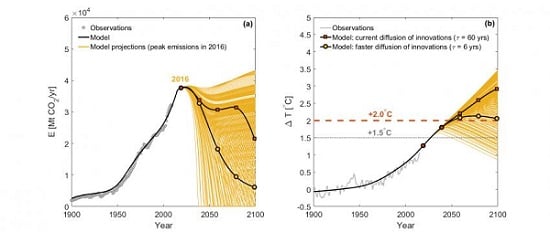 Projections of future emissions and the speed of innovation needed to meet global emissions targets. Credit: Gabriele ManoliThe researchers conclude that per-capita carbon dioxide emissions have increased about 100% percent every 60 years -- typically in big jumps -- since the Second Industrial Revolution. This “punctuated growth” has occurred largely because of time lags in the spread of emission-curbing technological advances, which are compounded by the effects of rapid population growth.
The analysis used delayed differential equations to calculate the pace at which global per-capita CO2 emissions increased since the end of the 19th century and start of the 20th. The researchers then compared this pace to the speed of new innovations in low-carbon-emitting technologies.
Using these historical trends coupled with projections of future global population growth, the likely pace of future emissions increases was estimated and the speed at which climate-friendly technological innovation and implementation must occur to achieve the Paris Agreement’s goals was determined.




The global goals as in 2 deg C from Paris are unobtainable regardless what "clean" technology is being chucked at it. There is simply no relation of "Clean" and temperature.
And Earth simply does not care about calculated temperatures and not at all about median temperatures.
So where does this go?