Smart Meter Breaks Down Energy Use by Appliance
John Simpson | December 07, 2016Researchers from the Fraunhofer Institute for Microelectronic Circuits and Systems (IMS) have developed a method that breaks down total energy consumption by appliance using a single, high-tech electric meter. A prototype is set to go on sale in summer 2017.
Non-intrusive load monitoring (NILM) technology, developed at Fraunhofer, is based on a simple principle: each device has a pattern of energy consumption that gives rise to a type of signature or “fingerprint” within the power grid. Using algorithms, it is possible to identify this signature within total energy consumption and thus determine energy consumption rates for individual appliances. Only one meter capable of taking three-phase current and voltage measurements is needed to do so. This eliminates the installation and maintenance of multiple meters.
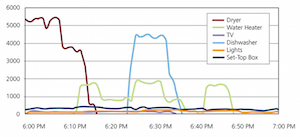 A software program visualizes the power consumption of each device in real time. Image credit: ©Fraunhofer IMS.To supply the algorithms with sufficient data, the smart meter measures energy intake at a scanning frequency of up to 1 megasample per second. Among other things, the meter records interference voltage, i.e., the noise produced by devices in the power grid. Which devices are in use can be determined based on the various frequencies of the interference voltage.
A software program visualizes the power consumption of each device in real time. Consumers can determine when the coffee maker switches itself on, the washing machine is spinning or a light has been switched off. Users can also identify when an appliance is functioning irregularly because faults give rise to altered consumption signatures. If a refrigerator develops a faulty seal, for instance, increased energy use will draw attention to it.
Across the industrial, trade and commerce and service sectors, NILM technology could result in energy savings of more than 12%, Fraunhofer researchers estimate. Companies can analyze their power consumption during production and determine which components in a product use high levels of energy during manufacture. Peak load times in the power grid can also be recorded and therefore avoided.
“A single electric meter can monitor over 20 devices," says Dr. Gerd vom Bögel, head of the business unit at IMS. "Conventional meters, in contrast, only show total energy consumption by all connected devices—for instance, that a light, fridge and toaster combined have used a total of 500 watts."