Making Red Mud Greener
John Simpson | November 29, 2016A team of materials science researchers at Worcester Polytechnic Institute (WPI) is attempting to develop a commercially viable process for recovering valuable metals from red mud, a byproduct of aluminum production that is currently stored in holding ponds around the world.
Red mud is the caustic material left over after aluminum is extracted from bauxite. Approximately four billion tons of the waste material is stored globally in ponds where aluminum production plants are based, primarily in Canada, Australia, Greece, and the southeastern United States.
About 120 million tons of red mud waste is produced yearly. In addition to constituting an economic loss the waste poses environmental risks that include the leaching of harmful chemicals into groundwater.
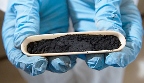 A valuable magnetic reduced iron oxide is extracted from red mud. Image credit: WPI“We’re trying to help the environment by getting rid of these ponds, which can leak and destroy surrounding ecosystems,” says team leader Brajendra Mishra, director of WPI’s Center for Resource Recovery and Recycling. “If our process is successful, we can produce a valuable product while also reclaiming that land.”
The process the WPI team has developed and tested in the lab can extract a magnetic reduced iron oxide from red mud. The material can then be sold to companies that use it to make pigments for construction materials and produce a variety of agricultural applications for soil and crop growth.
After WPI receives the red mud, from any of three sources—a Canadian mining company, a firm in Greece and an alumina plant in Gramercy, Louisiana—a two-step recovery process takes place. It first undergoes a gas-based carbothermic reduction process before being placed on an apparatus for separation. The team then uses a magnetic separator to remove the iron oxide from non-magnetic materials such as alumina, calcium silicate and other elements.
Depending upon its purity, the iron oxide can sell for up to several thousand dollars per ton. Because iron oxides can make up as much as 60% of red mud, a viable recovery method could be lucrative, Mishra says.