Flexible Supercapacitor May Enable Phone Charging in Seconds
Chuck Heschmeyer | November 25, 2016A smartphone that recharges in seconds and stores its energy for a week or more is getting closer to reality.
A team of University of Central Florida researchers has developed a new process for making flexible supercapacitors that can store more energy and be recharged more than 30,000 times without degrading.
The lithium-ion batteries common in today’s smartphones begin to degrade, or gradually lose their ability to hold a charge, in about 18 months. Scientists have been studying the use of nanomaterials to improve supercapacitors that could enhance or even replace batteries in electronic devices. But to store as much energy as a lithium-ion battery, a supercapacitor would have to be a lot larger.
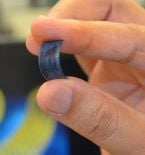 The flexible supercapacitors are composed of millions of nanometer-thick wires.To solve the problem, researchers have begun experimenting with super-thin two-dimensional materials such a graphene to apply to supercapacitors, but with limited success.
“There have been problems in the way people incorporate these two-dimensional materials into the existing systems; that’s been a bottleneck in the field,” says lead investigator Yeonwoong “Eric” Jung, an assistant professor in UCF’s NanoScience Technology Center and Materials Science & Engineering Department. “We developed a simple chemical synthesis approach so we can very nicely integrate the existing materials with the two-dimensional materials.”
Jung’s team has developed supercapacitors composed of millions of nanometer-thick wires coated with shells of two-dimensional materials. A highly conductive core facilitates fast electron transfer for rapid charging and discharging. The uniformly coated shells of two-dimensional materials yield high energy and power densities.
For small electronic devices, UCF researchers believe their integrated two-dimensional material surpasses conventional materials in terms of energy density, power density and cyclic stability, that is, the number of times it can be charged, drained and recharged before beginning to degrade.
They say their process yields a supercapacitor that doesn’t degrade even after it’s been recharged 30,000 times, versus a few thousand times for other formulations of supercapacitors with two-dimensional materials and a mere 1,500 times for a typical lithium-ion battery.
Efforts to patent the new process are underway.