A Better Lure to Control an Avocado Pest?
John Simpson | November 21, 2016An Agricultural Research Service (ARS) entomologist has developed a tool for Florida avocado producers in their fight against a disease that is killing their trees. The lure makes it easier to detect and control the invasive pest behind the infestation.
Laurel wilt disease was first detected in Miami-Dade County avocado groves in 2012 and has since spread to nine southeastern states. If left unchecked, it could wipe out the $468 million avocado crop in California and the $1.2 billion avocado industry in Mexico. The disease also has nearly eradicated trees that were once major parts of coastal forests in the Southeast, including the swampbay and redbay.
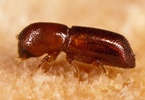 Redbay ambrosia beetles transmit a fungus that causes laurel wilt disease of avocado trees. Image credit: Stephen Ausmus.Laurel wilt is spread by the redbay ambrosia beetle (RAB), which bores into the tree and deposits a fungus, Raffaelea lauricola, triggering a defensive response that blocks the flow of water to the upper tree and limbs. Once infected, a tree can wilt and die within two months.
To combat the problem, ARS' Paul Kendra and his commercial partner, Synergy Semiochemicals Corp., have developed an improved lure that emits high levels of a key attractant. The compound, known as a-copaene, is found in the wood of avocado and other laurel trees and is believed to be an important ingredient in the bouquet of compounds that the beetle uses to find host trees.
Kendra and his colleagues distilled cubeb oil, separating out its constituent chemicals for analysis, and exposed RAB to some of the most promising compounds to determine which ones were the most attractive. Based on their results, they developed two prototype lures and then compared how well they attracted RABs vis-a-vis the current cubeb lure during a three-month field trial.
The experimental lure with 50% a-copaene captured two to three times more beetles and could detect them even when they were present in very low numbers in avocado groves. The lure attracted RABs for the entire three-month trial.
Synergy Semiochemicals is now producing the new lure for forestry and agricultural use.