Could Bacteria Create Building Foundations?
John Simpson | November 15, 2016Pressure-responsive bacteria could create the foundations of buildings in the future, new research suggests.
A team of scientists led by Dr. Martyn Dade-Robertson, reader in design computation at Newcastle University, in the UK, is investigating how to create a new kind of material—"biocement"—in which engineered cells react to changes in the environment and strengthen the soil around them.
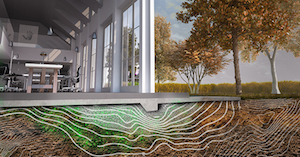 Researchers seek to develop a responsive material that could create foundations for buildings and avoid the need to dig trenches and fill them with concrete. Image credit: Newcastle University.The team, which includes researchers from Northumbria University, UK, has identified dozens of genes in E. coli bacteria that are regulated by pressures of 10atm (10 times that of sea level). Using these, they are modifying the bacteria to create a "gene circuit" that would enable the bacteria to respond to their environment by producing biocements.
"We are trying to create a responsive material that could have broad architectural applications—for example, creating foundations for buildings without needing to dig trenches and fill them with concrete,” says Dade-Robertson.
The significance of the research could stretch beyond the development of biocement, according to the researchers. As part of the project, they have developed a new type of computer-aided design application. The application models pressures and stresses within a volume of soil under a building and maps different types of gene expression—predicting where the bacteria are likely to produce materials.
“The application hints at a new way of doing design," says Dade-Robertson. "Imagine designing structures at the scale of a building by altering the DNA of microscopic bacteria cells. Such a technology would push well beyond the current state of the art and challenge a new generation of engineering designers to think at multiple scales from molecular to the built environment and to anticipate civil engineering with living organisms.”