Resistive Force Theory Testing Simplified
John Simpson | October 05, 2016For years, engineers have used a set of equations known as resistive force theory (RFT) to calculate how much force is required to move an object through fluids or granular material—such as propelling an unmanned rover through the depths of the ocean or pushing a shovel through sand. But they didn’t know why the theory works so well, particularly with granular materials.
Now, Hesam Askari, assistant professor of mechanical engineering at the University of Rochester, and his mentor at the Massachusetts Institute of Technology (MIT) have provided the answer with a theoretical model they say will enable researchers to quickly calculate the force required to move objects over or through whole classes of previously untested granular materials in a variety of settings. Applications could range from designing vehicles to traverse granular terrains on distant planets to understanding how lizards “swim” through sand here on Earth—even to targeting the delivery of drugs through particle-filled tissues in the human body.
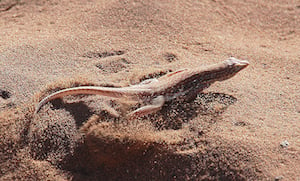 Applications for the new model could range from designing vehicles to understanding how lizards “swim” through sand. Image credit: Pixabay.RFT was developed in the 1950s to describe how objects move through viscous fluids. In 2008, researchers at Georgia Tech found that the theory with some variations could even more precisely describe the force needed to move objects through granular material, which is a much more difficult medium than fluids to model.
And empirical-based testing of RFT can be extraordinarily time consuming. Typically, researchers must first create a small square plate made of the same material as the larger object they want to push through a given granular medium. They must then run hundreds of experiments to determine the forces that are exerted on the plate oriented at different angles as it moves in various directions. They must then proportionately multiply and add the findings to “reconstitute” the larger object and the total force exerted on it.
Working with his mentor, Ken Kamrin, associate professor of mechanical engineering at MIT, Askari identified two main properties of granular materials that allowed him to come up with a simple, predictive model that consistently replicated the empirical findings of previous RFT experiments—without having to actually do all those experiments. The properties are a friction coefficient that determines whether a granular material will flow and a separation rule to account for the temporary “hole” that forms behind the object as it moves, before the separated granules fill in behind it.
The novelty of the modeling approach is that it can simulate millions of particles as a continuum of matter. This will greatly simplify complicated modeling of discrete particles to a continuum simulation, with researchers working a few hours at their laptops, instead of having to wait two days for 24 Blue Hive processors to do the calculations.