
Watch: Granular minerals minimizes nuclear meltdown
S. Himmelstein | October 03, 2019A nuclear reactor meltdown often results in the release of corium, a hot molten mass  Researchers tested granular calcite and sand against lead oxide. The granular calcite and lead oxide had a leavening and cooling reaction, while sand did not produce a reaction. Source: Randy Montoyathat penetrates the reactor vessel. The mixture of nuclear fuel, fission products, control rods and other materials contaminates surroundings as it melts through the reactor, which could precipitate explosions as the corium reacts with concrete to create hydrogen gas.
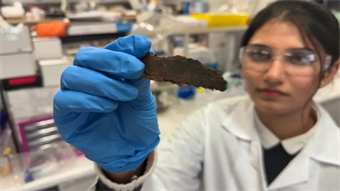
A technique to contain these hazards, based on sand-like mineral injection into the reactor core, has been devised by Sandia National Laboratories researchers.
Benchtop tests evaluated the efficacy of calcite, dolomite and granular silicon dioxide, or sand, in containing molten lead oxide powder used as a substitute for corium. When poured over the calcite and dolomite, gram-sized samples of molten material solidified due to a cooling effect of the reaction. The sand exerted no effect on the molten lead oxide. Similar results were documented in kilogram-scale tests, confirming the utility of injectable granular carbonates in slowing the progression of radioactive contamination.
The researchers hope to conduct larger scale experiments with depleted uranium prior to commercialization of the technology.


We have an abundant supply of waste to be made safe.
Half a Century of Nuclear Reactor "Safety" Fraud
Well, I am glad to see someone finally thinking about these low-hanging-fruit opportunities to make nuclear power facilities less hazardous. This stuff seems so obvious to me. I took one course on how to run a small research reactor in college half a century ago. I remember sketching out at the time a dome shaped pan for use under any reactor facility. It had fractal grooves with plain sand fill to spread and cool the corium and a circumferential ditch to capture the cooling corium in some calming granular medium. At the time I was thinking encapsulated non-flammable moderator materials (perhaps boron) and I am pleased with the dolomite idea since dolomite is cheap and used to line blast furnaces(thus non-flammable unlike say graphite.) Having seen this work, I would, indeed, make the dome shaped pan and surrounding trough out of dolomite as well. I talked it up a bit at the time but generally got blank stares and comments like: "we have smart people already engaged in fully adequate safety techniques." So, I eventually ran out of patience for someone more interested in the topic to step up and carry the water and, with some unease, decided to just get on with the rest of my own life.
Now, I see in this video that the "someone" is finally getting a round-tuit. I cannot help but think that it is waaaaay late considering 3mileIsland, Chernobyl, Fukishima, ... I just hope we do not have several more catastrophes before the simple, obvious, and effective technique matures and is universally deployed. Meanwhile, the green goblins should cool-their-tool on nuclear power promotion and use their quiet time to come up with some genuinely effective deep-time solution for nuclear waste storage to be perfected and then used before we accelerate our generation of that nasty stuff. I fear that they will compound their fraudulent claims regarding the safety of the waste issue just like they did with the melt-down issue. The waste issue seems to me to be far less tractable. In the half century I have been casually thinking about it I have only become more and more pessimistic that it can be economically addressed in a genuinely safe, scalable, and sustainable way over deep time. Claims that it does not need a deep-time solution are prima facie fraudulent.
______________
thewildotter
P.S. I went to Virginia Polytechnic Institute and State University and most of their buildings at the time had dolomite exteriors. My dorm was firebombed and the firemen just squirted a little water on the fire and you could barely see some soot stains. I already knew that dolomite was used in blast furnace linings, had mentioned it as good material for my meltdown catch pan but was pleased to be able to show a picture of the firebomb insignificant results to those whose ears I bent regarding meltdown prep. I would have posted that picture here but unfortunately it was destroyed in a flood in Manassas, VA in 1972 from Hurricane Agnes. I really did not know at the time just how prophetic a choice of materials dolomite was, but considering the topic video...
Here is Burruss Hall, the administrative building, sheathed in dolomite on the VT campus: