"Phase Separation" in Oxides Could Produce a Multifunctional Chip
John Simpson | September 25, 2016Researchers studying the behavior of nanoscale materials at the Department of Energy’s Oak Ridge National Laboratory (ORNL) have uncovered behavior that could advance microprocessors beyond today’s silicon-based chips.
Their study shows that a single crystal complex oxide material, when confined to micro- and nanoscales, can act like a multi-component electrical circuit. This behavior stems from an unusual feature of certain complex oxides called "phase separation," in which tiny regions in the material exhibit different electronic and magnetic properties.
According to the researchers, this means individual nanoscale regions in complex oxide materials can behave as self-organized circuit elements, which could support new multifunctional types of computing architectures.
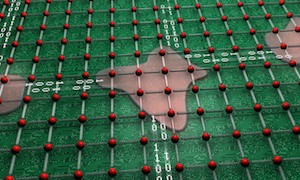 Complex oxide materials can self-organize into electrical circuits, creating the possibility for new types of computer chips. Image credit: ORNL.“Within a single piece of material, there are coexisting pockets of different magnetic and/or electronic behaviors,” says ORNL’s Zac Ward, the study’s corresponding author. “What was interesting in this study was that we found we can use those phases to act like circuit elements. The fact that it is possible to also move these elements around offers the intriguing opportunity of creating rewritable circuitry in the material.”
Because the phases respond to both magnetic and electrical fields, the material can be controlled in multiple ways, which creates the possibility for new types of computer chips.
As the computing industry looks to move past the limits of silicon-based chips, the ORNL proof-of-principle experiment shows that phase-separated materials could be a way beyond the “one-chip-fits-all” approach. Unlike a chip that performs only one role, a multifunctional chip could handle several inputs and outputs that are tailored to the needs of a specific application.
The researchers demonstrated their approach on a material called LPCMO, but Ward notes that other phase-separated materials have different properties that engineers could tap into.
The new approach aims to increase performance by developing hardware around intended applications, Ward says. That means that materials and architectures driving supercomputers, desktops and smart phones, which each have very different needs, would no longer be forced to follow a one-chip-fits-all approach.