Plasma Etching of Biochar Reduces Supercapacitor Costs
John Simpson | September 07, 2016Engineers from South Dakota State University have used biochar made from yellow pine, combined with a new method of creating the porous surface needed to capture electricity, to reduce the cost of supercapacitors.
The ability to absorb and discharge energy quickly makes supercapacitors integral to energy harvesting, such as in the regenerative braking systems of hybrid vehicles. However, supercapacitors are expensive. Supercapacitor-grade activated carbon can cost $15 per kilogram.
Raw biochar, however, requires activation to create the porous structure needed to trap ions. Traditional chemical activation requires a high temperature—in the range of 1,700 degrees Fahrenheit for two hours—and a chemical catalyst, followed by chemical washing and prolonged drying. This makes it a time-consuming, energy-intensive process.
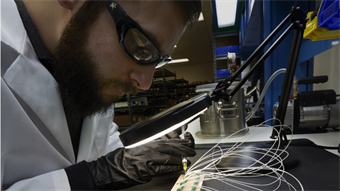
 Qi Hua Fan, associate professor of electrical engineering and computer science, is developing new electro-optical materials using this plasma-processing equipment. Image credit: SDSU. So Qi Hua Fan, associate professor of electrical engineering and computer science, instead used plasma etching to activate the biochar. For plasma etching, oxygen was excited by radio frequency through a dielectric barrier discharge. Fan then gave the activated biochar to Zhengrong Gu, associate professor of agricultural and biosystems engineering, who utilized the activated biochar to make the supercapacitors.
When the researchers compared capacitor performance, they found that those made using plasma treatment had 1.7 times higher specific capacitance, 171.4 Farads, compared to those made with chemical activation, at 99.5 Farads.
The process took only five minutes and required no external heating or chemicals.
In the Journal of Power Sources, Fan, Gu and Assistant Physics Professor Parashu Kharel explain: “Oxygen plasma was capable of creating various pore sizes that would allow easy access for the electrolyte ions to the porous surface, leading to a higher capacitance than the chemically activated biochar.” In addition, the oxygen plasma-activated capacitors had lower estimated resistance, 3.3 ohms, compared to 14.5 ohms for the chemically treated capacitors. This was attributed to the ions having easier access to the micropores and mesopores created by plasma processing.
However, he points out, the process must be optimized for each type of structure. “Activation depends on [the type] of plasma, what conditions are used and how long we treat the material.”
Fan has filed a patent application for the plasma activation process and expects to apply for funding to expand this processing technique to other types of biochar.