"Second Skin" to Protect Against Bio and Chem Agents
John Simpson | August 18, 2016Lawrence Livermore National Laboratory (LLNL) scientists have created a material that is highly breathable yet protects against biological agents. The material is a component of "smart" military uniforms that will be designed to protect against environmental chemical hazards.
High breathability is a requirement for protective clothing to prevent heat stress and exhaustion when military personnel are engaged in missions in contaminated environments. Current military uniforms are based on heavy full-barrier protection or permeable adsorptivity and often do not meet the demands of being both highly comfortable and protective.
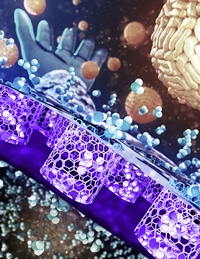 LLNL scientists are developing a flexible membrane with sub-5-nanometer, single-walled carbon nanotube pores. Image credit: Ryan Chen/LLNL.To create the material, the LLNL team fabricated flexible polymeric membranes with aligned carbon nanotube channels as moisture-conductive pores. The size of these pores (less than 5 nanometers, nm) is 5,000 times smaller than the width of a human hair.
"We demonstrated that these membranes provide rates of water vapor transport that surpass those of commercial breathable fabrics like GoreTex, even though the aligned carbon nanotube pores are only a few nanometers wide," says LLNL postdoctoral research fellow Ngoc Bui.
To provide high breathability, the composite material takes advantage of the unique transport properties of carbon nanotube pores. By quantifying the membrane permeability to water vapor, the team found that, when a concentration gradient is used as a driving force, aligned carbon nanotube channels can sustain high gas-transport rates.
The membranes provide protection from biological agents due to the fact that their pore size is significantly smaller than biological threats such as bacteria or viruses. Tests demonstrated that the aligned carbon nanotube membranes repelled Dengue virus from aqueous solutions during filtration tests, which confirms that the membranes provide effective protection from biological threats by size exclusion rather than by merely preventing wetting.
However, chemical agents are much smaller in size and require the membrane pores to be able to react to block the threat. To encode the membrane with a smart and dynamic response to small chemical hazards, LLNL scientists and collaborators are modifying these prototype carbon nanotube membranes with chemical-threat-responsive functional groups. These groups will sense and block the threat like gatekeepers at the pore entrance.
A second response scheme is also in development. Similar to how living skin peels off when challenged with dangerous external factors, the fabric will exfoliate upon reaction with a chemical agent.
"The material will be like a smart second skin that responds to the environment," says Kuang Jen Wu, leader of LLNL's Biosecurity and Biosciences Group. "In this way, the fabric will be able to block chemical agents such as sulfur mustard (blister agent), GD and VX nerve agents, toxins such as staphylococcal enterotoxin and biological spores such as anthrax."