Vortex Laser Boosts Data Transfer Rates
John Simpson | August 15, 2016For decades, researchers have succeeded in loading ever more components onto silicon-based computer chips. Their success explains why today’s smartphones have more computing power than the world’s most powerful computers of the 1980s, which cost millions in today’s dollars and were the size of a large file cabinet.
But scientists are running into a bottleneck in which existing technology may no longer meet society’s demand for data. Predictions vary, but some suggest that the capacity to increase the number of transistors per unit of area on integrated circuits in order to boost computing power could end within the next five years.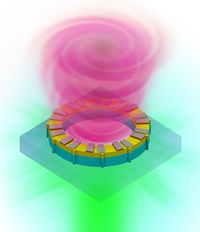 Illustration of a vortex laser on a computer chip. Image credit: SUNY at Buffalo.
Lasers are a central part of today’s optical communication systems, and researchers have used them in various ways to carry more information—most commonly by funneling different signals into one path. But these techniques—specifically, wavelength-division and time-division multiplexing—are also reaching their limits.
Research led by Liang Feng, assistant professor in the Department of Electrical Engineering at the State University of New York at Buffalo, may push laser technology forward using another light manipulation technique called “orbital angular momentum,” which distributes the laser in a corkscrew pattern with a central vortex.
While such lasers are usually too large to work on today’s computers, the research team was able to shrink the vortex laser to the point where it is compatible with computer chips. Because the laser beam travels in a corkscrew pattern—encoding information into different vortex twists—it is able to carry 10 times or more the amount of information of conventional lasers, which move linearly.
The researchers say they believe that the vortex laser is one component of many—including advanced transmitters and receivers—that will be needed to continue building more powerful computers and datacenters.