Cyber-Physical Systems Research Aims for Safer Construction-Site Temporary Structures
John Simpson | August 09, 2016A Pennsylvania State University researcher is developing cyber-physical systems (CPS) that integrate computational algorithms and physical components to monitor the safety of temporary structures used on construction sites.
While CPS has already been implemented in the manufacturing, transportation and healthcare industries, its benefits to the construction industry are still being explored. Now, a study completed by architectural engineering PhD candidate Xiao Yuan has investigated how linking sensors on structures with virtual models can better ensure the safety of the more than 75% of construction workers who labor on or around sheeting and shoring, temporary bracing or guide rails, soil backfill, formwork systems and scaffolding.
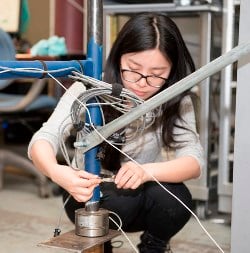 Architectural engineering student Xiao Yuan connects and secures CPS sensors on a temporary-structure simulation. Image credit: Penn State.Yuan’s research focused on how CPS can be used to prevent failures of temporary structures through virtual prototyping, data acquisition systems and communication networks. This setup allows for real-time inspections, remote interaction, early warnings of potential failures and immediate notification to workers through an application available on a mobile platform.
“Once there is a problem, our virtual model will know,” Yuan says. “It’s just like when we feel something if it hurts—the virtual model will feel if there is a problem.”
The bidirectional workflow of Yuan's CPS allows for sensors located on the temporary structures to collect and send data to LabVIEW, a data acquisition system, where information on the temporary structure is processed and sent on to the cloud database. Queries every two seconds monitor the structural performance based on predefined values. If no potential safety concern or failure is found, the system continues to collect information from the sensor without any changes.
If a potential failure is discovered during the CPS analysis, the potentially hazardous section is highlighted in the 3D virtual model, indicating the need for further investigation. Warning notifications and detailed structural deficiencies are sent from the virtual model to mobile devices used by on-site construction workers, safety inspectors and project managers. These people are then able to use the information to address a potential problem and avoid structural failure, injury or fatality due to structural deficiency.
Yuan says that in addition to continuously monitoring structures and detecting possible failures, the CPS research anticipates the system developing as an “intelligent” virtual model. Her investigation is using machine-learning technology to generate a self-learning model based on big data analysis.
“The virtual model can learn from historical behavior for intelligent identification of potential hazards in the future,” she says.
The next step in the research project is to better determine job site costs and installation factors. “There are some limitations to testing the system in the labs,” she says. “If we want to apply this technology in the real world, we need to test in the real world.”