
Lower Truck Cabs Would Reduce Blinds Spots, Study Says
John Simpson | August 06, 2016Trucks with high cabs have more blind spots than other heavy goods vehicles (HGVs) and thus pose greater risk to pedestrians, bicyclists and motorcyclists, research by Loughborough University in the UK has found. Transport for London commissioned the study to better understand blind spots across HGVs—trucks of over 3,500 kilograms in weight—as they are disproportionately involved in collisions involving so-called "vulnerable" road users in the UK capital.
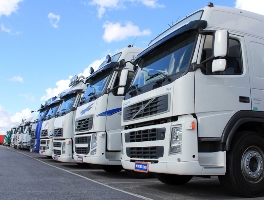 The height of the cab above the ground was found to be the key factor affecting the size of the direct-vision and indirect-vision blind spots. Image credit: Pixabay. A research team from the Loughborough Design School digitally scanned 19 of the most popular HGVs—including construction, distribution and long-haul vehicles with high and low cab designs—to create CAD models whose blind spots could be accurately assessed. Then, using accident data, the team was able to recreate scenarios involving vulnerable road users, placing them in a number of defined locations adjacent to all 19 vehicles to plot exactly where blind spots existed.
“We found that all standard vehicle configurations have blind spots [that] can hide vulnerable road users from the driver’s direct vision," says senior lecturer and project leader Steve Summerskill. However, he says that the height of the cab above the ground is the key factor affecting the size of the direct-vision and indirect-vision blind spots. Low-entry cab designs, meanwhile, demonstrated real benefits in terms of reducing direct-vision blind spots when compared to standard vehicle designs.
“If you seriously want to reduce the number of collisions involving vulnerable road users and HGVs, you have to improve the direct field of vision for drivers—and from our research this means lowering HGV cab designs or adopting low-entry cab designs,” Summerskill says.
The team is calling for the development of a standard to define what should be visible through direct vision from an HGV.




Seriously? The higher cab height also allows the driver to see well ahead allowing him/her adequate time to respond to drivers suddenly braking several vehicles in front of the truck. Lowering the driver would most certainly result in the rise of catastrophic and deadly rear end collisions.
Driver training, mirror configuration, proximity warning devices and cameras have proven to make for fewer accidents. The driver is at the top for a reason. How can the driver be lowered without lengthening the cab and creating a whole new set of problems?
Why not lower the cockpits of airplanes? If you've ever taxied a plane around an airport you know that the sightlines are nonexistent. What makes it safe to do so is pilot training and ground coordination.
I can only imagine this idea is being pushed by people that will profit from such a measure.