Completion of Air-Breathing SABRE Engine Prototype Tabbed for 2020
John Simpson | July 29, 2016The European Space Agency (ESA) has committed to supporting development of the next phase of the Synergistic Air-Breathing Rocket Engine (SABRE), a design intended to power the flight of single-stage-to-orbit spaceplanes.
ESA is investing €10 million ($11.1 million) in SABRE, joining £50 million ($66 million) from the UK Space Agency, to support Reaction Engines Ltd.'s commencement of the design of the engine configuration and a prototype demonstrator. ESA says the air-breathing rocket engine could begin test firings in four years.
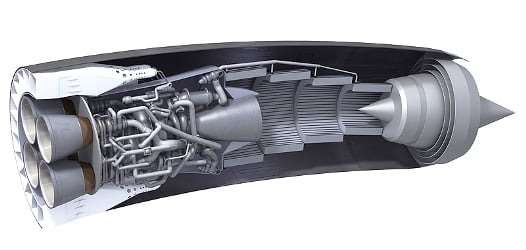 The air-breathing SABRE rocket engine could begin test firings in four years. Image credit: Reaction Engines Ltd.Reaction Engines has been working on the SABRE technology for years. Their design emphasizes the engine's use of atmospheric air in the early part of its flight to orbit before switching to rocket mode for its final ascent to space.
The idea is that the spaceplane would accelerate to approximately Mach 5 in the lower atmosphere using air breathing before switching to internal liquid oxygen. Because the air is coming in fast, it needs to be slowed down in order to burn in the engine. But doing so raises the air temperature to approximately 1,000°C, which can exceed engine material temperature limits.
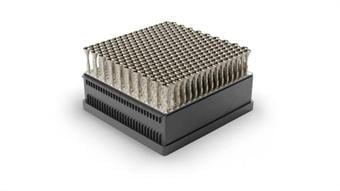
For that reason, the engine uses a "precooler" to chill the air to a temperature that is then usable by the engine. In 2012, ESA oversaw testing of the precooler, designed to chill the hot airstream by 1,150°C in just a hundredth of a second—at the same time avoiding the formation of potentially dangerous ice.
Additional research and development has focused on demonstrating the feasibility of other elements of the engine, such as its novel rocket nozzles, air intake design and thrust chamber cooling. A ground demonstrator engine, which the parties believe could be completed by 2020, will attempt to bring all these elements together to verify the performance of the complete engine cycle.
Ultimately, the goal is to produce low-cost, reliable and reusable engines, potentially enabling future vehicles that could perform the equivalent job of today’s rockets while operating like an aircraft.