Smart Material Has Shape Memory, Self-Healing Properties
John Simpson | July 24, 2016Washington State University (WSU) researchers have developed a multifunctional smart material that can change shape from heat or light and assemble and disassemble itself.
Smart materials that can react to external stimuli, such as light or heat, have a variety of potential applications—as actuators, drug delivery systems and self-assembling devices. For instance, smart materials could change shape to unfold a solar panel on a space satellite without requiring a battery-powered mechanical device.
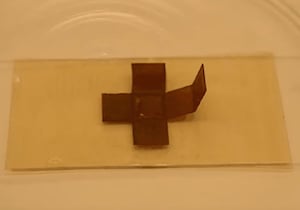 The material reacts to light, can remember its shape as it folds and unfolds and can heal itself when damaged. Image credit: WSU. But smart materials haven’t come into widespread use because they are difficult to make and often can perform only one function at a time. Researchers have also struggled to reprocess such materials so that their special properties can continually repeat themselves.
The WSU research team, led by Michael Kessler, professor in the School of Mechanical and Materials Engineering, worked with a class of long-chain molecules known as liquid crystalline networks, which provide order in one direction and give materials unique properties. The researchers took advantage of the way the material changes in response to heat to induce a three-way shape-shifting behavior, adding groups of atoms that react to polarized light and using dynamic chemical bonds to improve its reprocessing abilities.
The resulting material reacts to light, can remember its shape as it folds and unfolds, can heal itself when damaged—and its movements can be preprogrammed and its properties tailored. For instance, a razor blade scratch in the material can be fixed by applying ultraviolet light.
A video of the material moving in response to light and heat can be viewed here.