Cooling Data Center Energy Demand
David Appleyard | July 21, 2016Continuing global growth in the on-line sector and so-called cloud services means a comparable and significant increase in the power use associated with those services. Major internet-based businesses such as Google, Amazon, Facebook and Microsoft are pushing for more dedicated renewable energy to meet their specific needs, but systems efficiency can also make a major contribution to curbing energy use. Emerging standards have a key role to play.
Driven by the inexorable rise of web-based services in the digital age, data centers – effectively giant racks of servers and digital storage capacity – begin to place an increasingly significant load on national power systems.
Clearly, this demand will continue to show growth in the coming years. Industries such as the medical and healthcare sector are increasingly outsourcing data services, commercial transactions through web-based retailers and the financial services sector are soaring and consumer services such as streaming video are all contributing to spectacular growth in the number of data centers and their use.
While tablets, laptops and phones may appear to consume relatively little power, collectively the IT infrastructure required to support them represents a major source of power demand. Doug Alger, Cisco IT Architect, says “Data centers are unique environments because you have a significant amount of power density within them – a room filled with cabinet after cabinet of computing equipment."
 A seawater-cooled data center in Finland. Image source: Google The Natural Resources Defense Council (NRDC), found data centers alone consumed upwards of 91 TWh in the U.S. in 2013.This figure is expected to increase by more than 50% by 2020 to roughly 140 TWh, the equivalent annual output of 50 power plants. Putting this into perspective, the U.S. generated around 4,100 TWh in 2013.
With data traffic set to triple in three years, according to Lux Research analysis, data center demand for energy and corresponding cooling capacity is set to follow in step. The research firm calculates that for each 100 W of server capacity power demand, some 50 W of cooling capacity is required. The demand for cooling equipment, already worth $1 billion a year globally, will rise by more than 60% in the next five years, it concludes.
Addressing Energy Demand
Recognizing the burgeoning energy demand represented by their services, major players in the data center sector have established their environmental credibility by securing renewable energy supplies or upgrading energy supply and cooling systems to improve system efficiency.
For instance, research from Emerson Network Power found that around half of all data center cooling systems in North America will be upgraded before the end of 2016 for improved reliability and efficiency.
In a survey of IT, facilities and data center managers, Emerson reveals that 40% of data centers have been upgraded in the past five years. Nearly 20% are in the process of being improved and about 31% will be upgraded in the next 12 months.
“Reliable performance and efficiency have always been critical to large data center performance,” says John Peter Valiulis, vice president of thermal management marketing for Emerson Network Power in North America. “As edge and cloud computing become ubiquitous, ensuring the health of cooling systems at smaller, localized data centers and computer rooms is crucial. Thermal upgrades are allowing companies to improve protection, efficiency and visibility within all these spaces.”
International standards, such as those developed by technical committees (TCs) and subcommittees (SCs) of the International Electrotechnical Commission (IEC), have a key role to play in cooling system performance. For example, IEC 60335-2-40:2016 deals with the safety of electric heat pumps, including air-conditioners, and of dehumidifiers incorporating motor-compressors. It also applies to electric heat pumps, air conditioners and dehumidifiers containing flammable refrigerant. Similarly, IEC subcommittee (SC) 61D considers appliances for air-conditioning for household and similar purposes. It has the scope to prepare international safety standards dealing with electrical equipment used in commercial or light industrial applications, primarily for the purpose of conditioning air.
The Emerson survey also revealed that 40% of data centers were also said to be adding economisers to provide ‘free cooling’ when outside temperatures allow.
Location, Location
In a bid to reduce cooling loads, some major players have relocated to regions with typically lower ambient temperatures, such as Nordic countries. For example, Google has a data center located in Hamina, Finland, which uses sea water from the Bay of Finland in its heat exchangers to reduce energy use from the server cooling load.
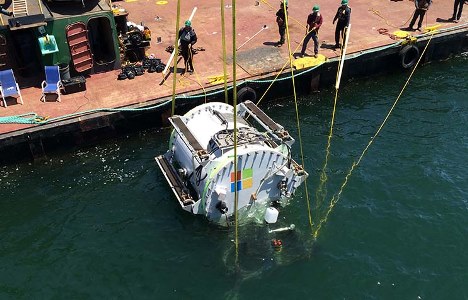 Microsoft recently concluded a trial program of a data center deployed under the sea.Taking this concept a step further, Microsoft recently concluded a trial program of a data center deployed under the sea. Project Natick seeks to understand the benefits of and difficulties in deploying subsea data centers worldwide. After a series of tests, the server was lifted out of the water late in 2015 for assessment. Power to the server was supplied by submarine power cables.
Although IEC international standards do not specifically cover submarine power cables, major submarine power cable manufacturers like ABB or Nexans rely on IEC standards when manufacturing products.
Mentions such as "the continuous current ratings are calculated according to IEC 60287 series of Standards" (ABB XLPE Submarine Cable Systems), or "Maximum value to IEC 60228" and "Calculated in accordance to IEC publication 60287" (Nexans Submarine Power Cables) are present throughout their marketing literature as evidence of compliance with internationally-recognized standards.
Achieving More
Even with such high-profile developments, Ory Zik, vice president of Analytics at Lux Research, says that much more could be achieved with coherent analysis. He says that, despite their sophistication, leading IT and computing giants in the U.S. use sometimes crude and outdated information to calculate the carbon footprint of their data centers. He claims this can lead to a shortfall of roughly 25% in emissions reporting.
“Data centers comprise the fastest-growing energy buying sector and the companies that run them have the most advanced data analytics tools at their disposal, as well as high-minded public commitments to sustainability. They should lead rather than lag, by using more accurate data to report on their emissions – and to inform the actions they take to reduce them,” he says.
However, Zik says that he believes that consumers will demand better transparency and traceability from companies. “I think that as we move forward, with more data devoted to understanding our environmental impact, consumers will have this coherent picture and once they have it, they will demand greener products like data from an environment perspective. This will force companies to improve their performance, because otherwise they will be losing customers.”
He points to the key role that emerging standards will play in benchmarking environmental performance: “We need to look at this more holistically and just apply data and calculate it [environmental impact] properly. I definitely see standards playing a key role.”
This is a point noted by NRDC, too. It concludes that “to move forward, systemic measures such as the public disclosure of efficiency metrics are necessary to create the conditions for best-practice efficiency behaviors across the data centre industry.”
One measure that may support this goal is ISO/IEC 19395:2015, an international standard for smart data center resource monitoring and control, which was prepared by ISO/IEC JTC 1 SC 39: Sustainability for and by Information Technology. ISO/IEC JTC 1 is the Joint Technical Committee set up by the International Organization for Standardization (ISO) and the IEC to develop International Standards for Information Technology.
Changing Standards
Jack Pouchet, vice president of Business Development and Energy Initiatives, Hyperscale Solutions, at Emerson Network Power, says that improved standards are a key route to greater energy efficiency. He cites 80 Plus, a voluntary certification scheme designed to promote efficiency in computer power supply units and launched in 2004 by Ecos Consulting. It certifies products that have an energy efficiency of more than 80%. Pouchet sets out a call for a similar standard focused on idling energy use, which he terms as “10 Minus.”
“They’re starting to focus on driving down the idle energy demand, but there is really no industry-wide push that these things should consume less than 10%, or less than 5%, or less than 1% [at idle]. There are no goals, there are no targets”, he says.
Pouchet calls for a data center equivalent of an X-prize for a production server that uses less than 10% of energy at idle.
As standards evolve to reflect more accurately the reality of data centers, other avenues to energy efficiency are emerging, too.
For example, ASHRAE, the American Society of Heating and Refrigeration and Air-Conditioning Engineers, has published updated standards for temperatures and humidity for computing equipment in data centers.
Says Alger: “Over time they have gradually broadened what they consider to be acceptable ranges. As those ranges expand, this opens up more flexibility.” Bringing in outside air cooling is one way that efficiency is being enhanced. The idea is to let Mother Nature cool the data center, rather than having to run the condensers in a facility’s air conditioning system.
Alger says, “I certainly think standards can play a key role in the behavior that they encourage for people as they design and operate data centers.”