Ultra-thin Solar Cells Could Power Wearable Electronics
Engineering360 News Desk | June 30, 2016Scientists in South Korea have succeeded in making an ultra-thin photovoltaic flexible enough to wrap around a pencil. The thin bendable solar cells perform just as well as thicker, more rigid ones and could be used to power the next generation of wearable electronics.
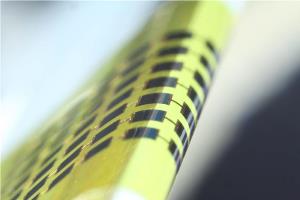 Ultra-thin solar cells are flexible enough to bend around small objects such as a 1mm-thick edge of a glass slide, as shown here. Source: Juho Kim, et al/ Applied Physics Letters Developed by engineers at the Gwangju Institute of Science and Technology, the photovoltaic is made of the semiconductor gallium arsenide and is a scant 1 micrometer thick, much thinner than an average human hair. By comparison, conventional photovoltaics are often hundreds of times thicker, and even most thin photovoltaics are up to four times as thick.
Researchers stamped the cells directly onto a flexible substrate without using an adhesive, as that would add to the material's thickness. The cells were “cold welded” to the electrode on the substrate by applying pressure at 170 degrees Celsius and melting a top layer of material called photoresist that acted as a temporary adhesive. The photoresist was later peeled away, leaving a direct metal-to-metal bond. The metal bottom layer also acts as a reflector to direct stray photons back to the solar cells.
Researchers then tested the device’s efficiency at converting sunlight to electricity and found it to be comparable to similar thicker photovoltaics. Bending tests showed that the cells could wrap around a radius as small as 1.4 millimeters.
The team also performed numerical analysis of the cells, finding that they experience one-fourth the amount of strain of similar cells that are 3.5 times as thick.
The production process showed that efficient, super-thin bendable photovoltaics can be made using a small amount of material. Since the thin cells can be integrated onto glasses frames or fabric, researchers believe they could power the next wave of wearable electronics.