Cellulose Research Could Lead to Tailored Biofuels
John Simpson | June 21, 2016Scientists have identified new steps in the way plants produce cellulose, the component of plant cell walls that provides strength and forms insoluble fiber in the human diet. The findings could lead to improved production of cellulose and guide plant breeding for specific uses such as wood products and cellulosic ethanol fuel.
The research identified several proteins that are essential in the assembly of the protein machinery that makes cellulose, says Staffan Persson, professor at the University of Melbourne's School of BioSciences, who carried out the work with an international team of scientists. “We found that these assembly factors control how much cellulose is made. So plants without them cannot produce cellulose very well, and the defect substantially impairs plant biomass production.”
The newly discovered proteins are located in an intracellular compartment known as the Golgi, where proteins are sorted and modified. If the function of this protein family is abolished, the cellulose-synthesizing complexes become stuck in the Golgi and have problems reaching the cell surface, where they normally are active.
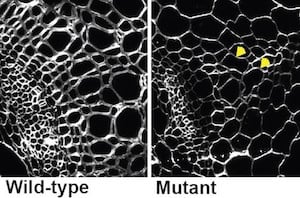 Section of wild-type stems and mutant stems. A substantial reduction in cell wall thickness is highlighted by the yellow arrowheads. Image credit: University of Melbourne.“The findings are important to understand how plants produce their biomass," says Paul Dupree, professor in the University of Cambridge Department of Biochemistry.
Greenhouse gas emissions from cellulosic ethanol, which is derived from the biomass of plants, are estimated to be roughly 85% less than from fossil fuel sources, Dupree notes. "Research to understand cellulose production in plants is therefore an important part of climate change mitigation.”
Moreover, using cellulosic plant materials avoids the food-versus-fuel conundrum that presents itself when corn is used as the basis for bioethanol, Dupree notes. “It is therefore of great importance to find genes and mechanisms that can improve cellulose production in plants so that we can tailor cellulose production for various needs.”
Previous studies by Persson's and Dupree’s research groups, together with those by other scientists, have identified many proteins that are important for cellulose synthesis and for other cell wall polymers. By adding to the scientific understanding of how the bulk of a plant's biomass is produced, the current study could help inform new industrial applications research.