The Need for Project Quality Management
Peter G. Hessler | June 09, 2016In the engineering, procurement and construction (EPC) world, the key business driver is money: money to make, money to save and money to take to the bank. To ensure that these three functions are integrated, most project managers use some system/s of risk management.
One of those systems usually is related to quality management, whether it’s in the engineering phase, the procurement phase, the construction phase, or all three. In other words, the use of a good quality management program mitigates risk.
The Story
Let’s continue with the chemical plant referenced in previous articles. (See “Good Engineer or Good Project Manager? Cost Considerations” and “Good Engineer or Good Project Manager? You Can Be Both.”) In addition to the schedule and cost management responsibilities that the plant engineer-turned-project manager is now responsible for, there is also the responsibility for ensuring that the finished project runs without issue for a very long time.
By the time this chemical plant was completely constructed, commissioned and started up, a period of 30 months had elapsed. There was a 20-month period of EPC work. Then there was another 10-month period of commissioning and startup. But, finally, the plant was up and running. The contractors had demobilized and the commissioning and startup teams had disbanded. The plant was on its own and the plant engineer-turned-project manager was back to being a full-time plant engineer.
More than a year passed and everyone was pleased with the way the new systems were operating. Then, in the wee hours of a mid-week production shift a major pressure excursion occurred inside one of the in-plant common services. This pressure excursion caused an expansion joint in one of the piping runs to rupture and spray a noxious fluid that was being carried within this system. It forced a complete plant shutdown since this common-service system served almost all of the production lines within the newly operating plant. What caused this unexpected calamity to happen?
The Specifics
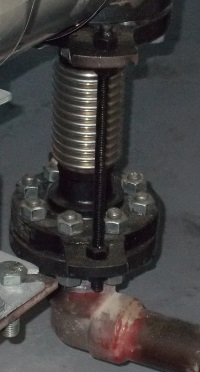 As-designed expansion joint. Image source: Construction Business Associates.During the engineering phase of the project, the designers specified a certain type of expansion joint to be used in the piping runs for the in-plant common service. It was to be a bellows-type of joint with solid retaining rods to prevent the joint from flexing beyond its planned-for travel during expansion. The system was designed so that, in the event of a pressure excursion beyond the design limit, the expansion joints would stop expanding. The excess forces would be transferred away from the expansion joints and into the piping hangers that carried the complete system – a fail-safe mechanism, or so it was planned.
When the project moved into the procurement phase, the purchasing department missed the need for the expansion joints to have retaining rods and ordered expansion joints without them. The reason that this happened was that the design was made using 3D modeling software and without detail drawings. The need for the retaining rods was not clearly identified, and no one from engineering checked up on what the purchasing people were buying.
Then, the expansion joints arrived on site, several hundred of them. As these expansion joints were being installed during the construction phase, no one performed any type of quality check to ensure that what was installed was what had been engineered. Unfortunately, there was no quality management program for the site construction work, just as there was no quality management of the purchasing activities. So the “wrong” expansion joints—hundreds of them—were installed.
 As-purchased and installed expansion joint. Image source: Construction Business Associates. Then, a year after the plant began operation, the pressure excursion and expansion joint rupture occurred. Because the “wrong” expansion joints had been installed, they were the unintended weak points in the system. One of those expansion joints, without retaining rods, extended beyond its designed limits and ruptured.
Immediately upon the expansion joint failure, all plant operations ceased and cleanup began. Simultaneously, several specialists in piping systems design were contracted to investigate why the accident happened. It did not take long for these third-party experts to determine that the installed expansion joints were not as originally engineered. Therefore, all of the remaining installed expansion joints needed to be replaced to prevent a recurrence of this event.
It took several months to manufacture, deliver and replace the joints with new, but now correct, ones. This replacement work prevented the plant from producing product as originally scheduled, necessitating third-party suppliers to meet customer demand. The cost of this fiasco was several million dollars, due to 1) the cost of the significant cleanup, 2) the cost of the investigation, 3) the cost of procuring, expediting and replacing the originally installed expansion joints, and, 4) the cost of subcontracting replacement product until the plant was back on line.
 The ruptured expansion joint. Image source: Construction Business Associates.Unfortunately, most of the costs directly associated with replacing the ruptured expansion joint, plus all of the others, were not recoverable due to the elapsed time since the work was originally completed; in other words, the one-year warranty period had expired. The costs associated with the replacement production also were not recoverable. In any event, if this had happened while the warranty was still in place, the exclusion of consequential damages contract clause would have negated cost recovery.
The Fallacy
This is a classic case of “tripping over dollars to pick up pennies.” The savings realized by not having a quality management plan in place during this EPC contract ultimately cost the plant owner several million dollars. The cost to have a quality management plan in place, either by the owner directly or by the EPC contractor, would have been significantly less.
In the EPC world a divergence of belief exists as to the ultimate cost of poor quality on projects. Some in the business believe that many contractors’ poor quality practices add as much as 20% to the cost of a project. That’s the equivalent of gaining only four days’ worth of value in a five-day workweek. There are others who argue that the cost is barely 5%. No one has a clear answer to this, but the point is not to argue who is right and who is wrong. The point is that no one disputes that poor quality exists in almost all projects and that poor quality carries a cost. Therefore, a quality management plan should always be used.
As this case study shows, the cost can be significant if no quality management program exists. Had the plant engineer-turned-project manager only forced the contractor to implement a rigid quality management program—one which included a review of the purchasing function as well as confirming that the installed systems met the intended design—this expensive problem could have been avoided.
Author: Peter Hessler, a former practicing engineer, is the president of Construction Business Associates, LLC (2310 Seven Lakes South, West End, NC 27376; 910-400-3113; Email: pghessler@constrbiz.com), a provider of business-management services to the power and process construction community. He has 40 years of experience in the power and industrial plant construction and maintenance industry, worldwide, having worked as an owner, contractor, and now as a consultant. He has a B.S. in Mechanical Engineering from Virginia Polytechnic Institute, and is the author of two books on the subject of power-plant construction management. For a more in-depth discussion on managing large and complex industrial projects, please contact him, or read his book, Power Plant Construction Management: A Survival Guide, an overview of which can be seen here.