Turning Batteries Upside Down
Riia O'Donnell | June 01, 2016Researchers at MIT have designed a liquid battery using an hour-glass shape for a design that is pump-free and that also may save money and allow for easier use.
Liquid flow batteries carry positive and negative electrodes in liquid form that are separated by a membrane. They typically depend on systems of tanks, valves and pumps all of which increased the potential for failure and leakage while increasing the cost.
(Learn more about batteries at the Engineering360 products and services pages.)
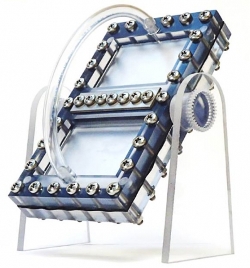 Battery power flows in gravity-fed design. Image Credit: MIT The version created by MIT researchers relies on gravity to move the liquid, which is a slurry. By changing the angle of the device, the rate of slurry flow may be controlled. The team suggests the device works best at a shallow angle, close to horizontal, which allows for a steady flow rate.
The initial version of the battery used as a proof of concept has flow on one side. The goal is to create a version where both sides, positive and negative electrodes, are liquid and flow and are separated by a membrane.
A flow battery makes it possible to choose from the two main characteristics of a battery system, power density and energy density: how much power the battery can deliver and how much it can store. The researchers envision their design could be used as compact, simple battery systems that could allow for expansion to grid-connected storage.