Machine Learning Accelerates Discovery of New Materials
Engineering360 News Desk | May 19, 2016Los Alamos National Laboratory scientists have demonstrated how an informatics-based adaptive design strategy, tightly coupled to experiments, can accelerate the discovery of new materials with targeted properties.
"What we've done is show that, starting with a relatively small data set of well-controlled experiments, it is possible to iteratively guide subsequent experiments toward finding the material with the desired target," says Turab Lookman, physicist and materials scientist in Los Alamos' Physics of Condensed Matter and Complex Systems group.
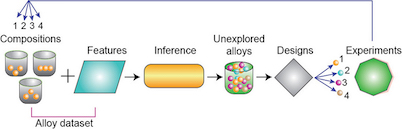 Feedback from experiments: augmented data set with four new alloys. Image credit: Los Alamos National Laboratory."Finding new materials has traditionally been guided by intuition and trial and error," notes Lookman. "But with increasing chemical complexity, the combination possibilities become too large for trial-and-error approaches to be practical."
To address this, Lookman, along with colleagues at Los Alamos and the State Key Laboratory for Mechanical Behavior of Materials, in China, employed machine learning to speed up the process. They developed a framework that uses uncertainties to iteratively guide the next experiments to be performed in search of a shape-memory alloy with very low thermal hysteresis. Such alloys are critical for improving fatigue life in engineering applications.
"The goal is to cut in half the time and cost of bringing materials to market," says Lookman. "What we have demonstrated is a data-driven framework built on the foundations of machine learning and design that can lead to discovering new materials with targeted properties much faster than before." The work made use of Los Alamos' high-performance supercomputing resources.
Although the Materials Genome initiative, issued by the White House Office of Science and Technology Policy in 2011, catalyzed interest in accelerated materials discovery, this study is one of the first to demonstrate how an informatics framework can actually lead to the discovery of new materials.
Much of the effort in the field has centered on generating and screening databases typically formed by running thousands of quantum mechanical calculations. However, the interplay of structural, chemical and microstructural degrees of freedom introduces enormous complexity, especially if defects, solid solutions, non-stoichiometry and multi-component compounds are involved, which the current state-of-the-art tools are not yet designed to handle. Moreover, few studies include any feedback to experiments or incorporate uncertainties.
Lookman and his colleagues focused on nickel-titanium-based shape-memory alloys, but the strategy can be used for any materials class (polymers, ceramics or nanomaterials) or target properties (e.g., dielectric response, piezoelectric coefficients and band gaps). This becomes important when experiments or calculations are costly and time consuming.
Although the work focused on the chemical exploration space, it can readily be adapted to optimize processing conditions when there are many "tuning knobs" controlling a figure of merit, as in advanced manufacturing applications. Similarly, it can be generalized to optimize multiple properties, such as—in the case of the nickel-titanium-based alloy—low dissipation and a transition temperature several degrees above room temperature.