Accelerated Bridge-Building Method Shortens Construction Time
Engineering360 News Desk | May 13, 2016The Rhode Island Department of Transportation (RIDOT) will use newly adopted accelerated bridge reconstruction techniques to replace two deficient overpasses in East Providence.
RIDOT will reconstruct the East Shore Expressway and McCormick Quarry bridges using precast foundation elements and by constructing the new bridge decks on large supports adjacent to the current bridges. When the new decks are finished this fall, the East Shore Expressway Bridge and the road underneath will be temporarily closed and, in one 80-hour extended-weekend closure, the existing bridge will be removed and the new one installed. The process will be repeated two weeks later for the McCormick Quarry Bridge.
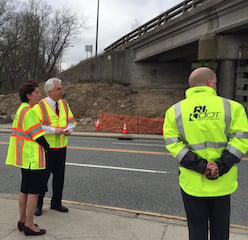 Rhode Island Governor Gina Raimondo (left) meets with RIDOT officials to view the McCormick Quarry Bridge construction site. Image credit: RIDOT.The accelerated bridge-building methods, RIDOT says, will dramatically shorten the overall construction timeframe, allowing for completion of the overpasses one year earlier than would be possible using conventional construction techniques. If RIDOT had not taken this approach, the department says the traveling public would have been impacted over the course of a year, with each ramp opened at only half capacity.
"Rhode Island has the worst bridges in the country, and with a great sense of urgency we are exploring all options, including innovative accelerated bridge construction methods like we're using on this project," says RIDOT Director Peter Alviti Jr.
Pre-construction activities to relocate utilities and minor drainage work began last fall, with full construction resuming in March. Ongoing operations include excavation of the soil behind the bridges' current supporting columns to make room for the construction of foundations for the new overpasses. RIDOT also is making use of geosynthetic reinforced soil walls for the bridges' abutments, which utilize layers of crushed stone and reinforcing fabric to quickly assemble the foundation elements.
In the coming weeks, construction will begin on the supporting structures for the new bridge decks, followed by the delivery of large steel beams for the decks. Work will progress through the summer to complete the decks to the point where they can be installed using self-propelled modular transporters—multi-wheel dollies capable of lifting the bridge decks off their temporary supports, driving them to the bridges' foundations and setting them in place.