Salt Aids Growth of Conductive Sheets
Riia O’Donnell | May 02, 2016A team of researchers from Philadelphia’s Drexel University and China’s Huazhong University of Science and Technology (HUST) and Tsinghua University has found that using crystals of salt allowed them to grow thin sheets of conductive metal oxides, resulting in materials that turned out larger and purer on a chemical level. Both factors improve the materials’ capacity for gathering ions and storing energy.
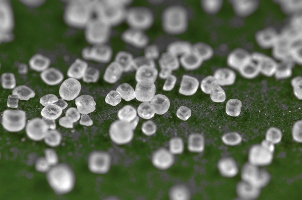 Table salt enhances materials for energy storage. Credit: Drexel University The research shows a way to grow oxide sheets that are stable and with less fouling that can sometimes be a result of introducing harsh chemicals. Additionally, the sheets are larger than sheets currently in fabrication. The current method for manufacturing metal oxide nanosheets--either deposition or chemical etching--leaves trace chemical residue that can contaminate the material and prevent ions from attaching. The researchers’ new method involves using salt crystals as a substrate. The salt allows the crystals to spread, forming a larger sheet of metal oxide.
The salt’s crystal structure must match the oxide’s crystal structure to prevent them from forming an amorphous film instead of the thin, nanocrystal. As the researchers developed the technique, salt crystals were perfect for growing oxide sheets of magnesium, molybdenum and tungsten. When the salt is dissolved after the growth process, the remains are two-dimensional sheets, nanometer-thin with high storage capacity.