Building a Better Blueberry Picker
Engineering360 News Desk | April 29, 2016Industrial engineers from nine universities are part of a four-year collaborative research project focused on increasing the efficiency of, and ergonomics associated with, blueberry picking in the United States.
Blueberry production constitutes an important source of economic growth in rural communities, especially for small and medium-sized farms. Currently, most fresh market blueberries in the U.S.—production of which has increased more than four-fold in the past three decades and now amounts to more than 500 million pounds with a farm gate value of $860 million—are hand harvested. As a result, rising labor costs, shortage of labor and low harvest efficiency can create bottlenecks to further development of the industry.
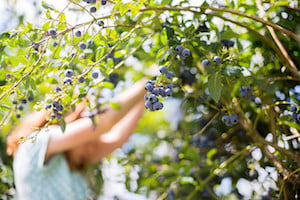 Annual U.S. blueberry production exceeds 500 million pounds with a value of over $860 million. Image credit: PSU.“The overall [project goal] is to develop a multidisciplinary approach to advance harvest efficiency and improve postharvest handling of fresh-market highbush blueberries by developing a scale-neutral harvest-aid system and advanced sensor technologies,” says principal investigator Changying “Charlie” Li, associate professor of biological engineering at the University of Georgia.
At the outset, Li contacted Andris Freivalds, professor of industrial engineering at Penn State University. He had heard about Freivalds’ previous research into the physical impact electronic shaking devices have on workers in blueberry fields and asked him to be a co-principal investigator on the blueberry harvesting project.
“Traditionally, shaking devices have caused too much damage to blueberries for them to be packaged and sold for human consumption; only hand-picked berries are of the quality expected by consumers when they are packaged and sold,” says Freivalds. “So we are looking at using several electronic shakers typically used in olive-harvesting operations to determine if one or more of them can be used to harvest berries that are of good enough quality to be packaged and sold, or at the very least that can be used to make blueberry preserves, jams and other consumable blueberry products in the United States.”
Freivalds and his graduate students began their research with a blueberry-harvesting simulation. To examine the effects shakers have on the operator’s body, doctoral student Eunsik Kim was hooked up to an electromyogram (EMG) to measure the stress on his muscles while operating the devices. He then mimicked the harvesting of blueberries on a blueberry bush that was set up in a lab environment.
“After using the shakers for only an hour, we were able to pinpoint some areas of interest for our research,” says Kim, who adds that he found the vibration of the machines to be particularly uncomfortable. The EMG showed some stress to Kim’s back and shoulders, but his forearm was the area that showed the most stress.
The next step will be for Freivalds to take his research on the road. After the spring semester, he and his students will visit farms along the east coast to have blueberry harvesters test shakers in the field. As was done with Kim, the stress on their muscles will be measured using an EMG. However, Freivalds and his team will also use an accelerometer to measure the vibrations from the shakers.
“The workers will be using a live blueberry bush, much different from the dead one in our lab, with blueberries on it," Freivalds says. "The shakers will have the netting mechanism on them to catch the berries and we will be in natural working conditions. This will allow us to see the effects the shakers have on harvesters’ posture, arms, etc.”
After Freivalds completes his observations, he will report his findings to the rest of the project researchers and recommend the best shaker, from an ergonomics and human perspective. His findings will be referenced, along with other researchers’ work, in the design of a new shaker.