EVs could earn drivers $1,100 a year via V2G
Michelle Hampson | September 30, 2026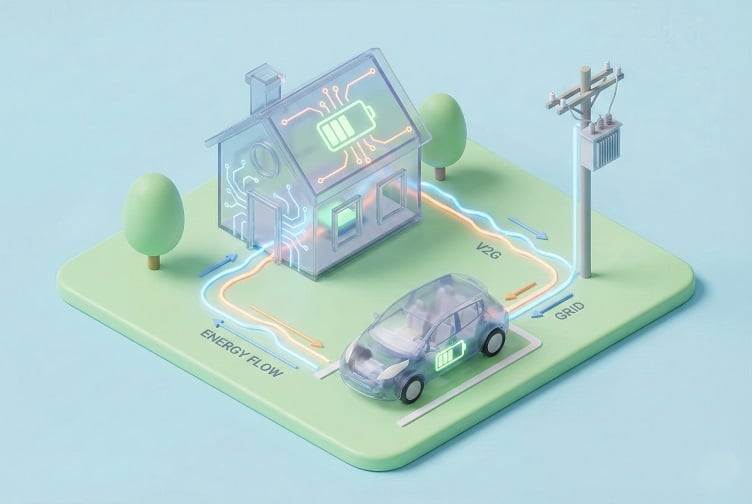 Depending on what V2G programs local grid providers offer, EV owners could make cash profits, or enjoy free charging of the vehicles by participating. Source: mostafa Mohamed/Adobe Stock
A rise in renewable energy sources means that finding ways to store power is more important than ever before. Fortunately, there is one solution finally breaking into markets that offers some relief for grids, in the form of vehicle-to-grid (V2G) technology. The concept is simple: when electric vehicles (EVs) are parked and not needed, their batteries can be used to store power on behalf of the grid and offload it as needed. The approach is a win-win for EV owners, grid operators, grid users and the environment.
However, despite the simplicity of the idea, rollout of this technology has been nearly 30 years in the making, and is only beginning to be implemented in real-world settings — primarily in a handful of European countries, but likely much more broadly in the next two to three years.
Willett Kempton, Ph.D., is a professor at the College of Earth, Ocean and Environment, and Department of Electrical and Computer Engineering at the University of Delaware, who helped pioneer the idea of V2G technology in the late 1990s. While he is surprised at how long it took for V2G to finally emerge on global markets, the timing is serendipitous. “We know that we're going to be awash in renewables, and so that means we need [energy] storage,” he said.
Wind and solar are greener options to appease society’s growing energy demands, but these sources can fluctuate greatly depending on weather conditions. Massive fleets of batteries at energy storage facilities are one option for storing power when renewable sources are in abundance, but these facilities are expensive to build.
In contrast, EVs are already flooding the market — with an estimated 250 million on the road globally by 2030 — inadvertently creating a fleet of mini power storage vessels on standby.
V2G helps the grid
Grid operators can save significant costs by using EVs for power storage. For example, one study on the German power grid estimates that V2G technology could lead to a 6% reduction in distribution grid investment costs by 2040. Lower grid costs mean lower prices for all customers too. However, EV owners who rent out their car batteries to the grid could see especially lucrative benefits.
Depending on what V2G programs local grid providers offer, EV owners could make cash profits, or enjoy free charging of the vehicles by participating. “They're providing enough value to the electric system that it's actually worth more than the cost of charging the car,” explained Kempton.
Studies suggest that owners of passenger EVs can make several hundred to more than $1,100 per year for renting out their batteries to grid systems via V2G programs. At the University of Delaware, and in partnership with Exelon and Delmarva Power, Kempton and his colleagues conducted a study over the course of a year and a half, and found that heavier vehicles with 33 kW charging, such as a van or bucket truck, could make even more profits — up to $3,195 to $9,741 per year.
Owners may have to incur some initial costs if they purchase a bidirectional charger for their home. AC chargers are more affordable, at about $1,500, than DC chargers, at about $5,000. However, this money can potentially be made back within two years under the AC condition, depending on compensation amounts from local V2G programs.
Importantly, V2G approaches can also bolster grid reliability. A study on the impacts of EV deployment in San Francisco found that V2G charging could avoid half of transformer overloads by 2050 compared to unidirectional smart charging, where power flows only from grids to EVs.
To top it off, V2G can help reduce grids’ reliance on fossil fuels, mitigating the need to burn fuel when renewable energy supply is low. For example, the same study modeled in San Francisco found that V2G deployment could result in an estimated reduction of the equivalent of 59,200 metric tons of carbon dioxide per year.
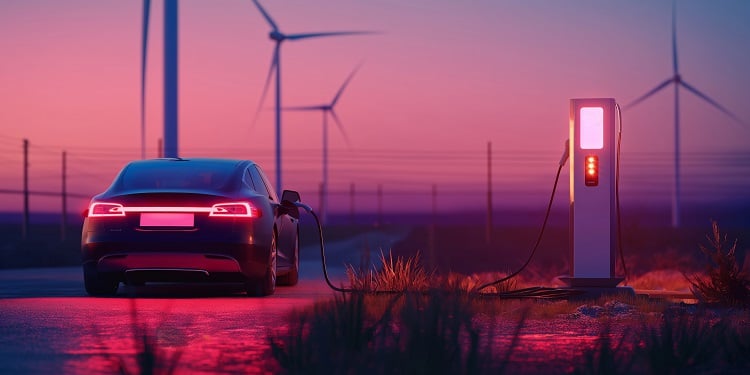 With more EVs on the road, companies are looking at new ways to get them involved in the grid. Source: zakiroff/Adobe Stock
V2G doesn’t degrade batteries
As V2G technology first emerged, there were concerns that excessive charging and discharging would cause EV batteries to degrade much quicker than normal. However, newer battery management systems and smart aggregators, which help manage and optimize an EV’s power charging and use, are mitigating the issue almost completely.
Kempton noted that, even with laptop batteries, people often fully charge them when not using them — and this can lead to quicker battery degradation. Same with EVs. But using smart energy management systems that keep EV batteries charged in the mid range — between 20% and 80% — is a good rule of thumb to avoid battery degradation, according to Kempton.
“A smart aggregator, even if you're doing a high throughput grid service, is probably going to cause less battery wear than just filling it up every night and leaving it full,” he said.
If EV owners are concerned about battery degradation while participating in V2G programs, Kempton suggested that they monitor their EV battery’s state of health over time, to ensure excessive battery degradation is not occurring.
Toward greater V2G adoption
Kempton said a key reason that it has taken a while for V2G technology to be more broadly adopted has to do with the complexities of electric policy for connecting batteries, and standards for exchanging power in a bidirectional manner — not necessarily technology for the physical exchange of power, but the communication required to control and monitor the exchange.
“It’s not like plugging in a toaster,” he emphasized. “There needs to be communication between the car and the charging station.”
Until recently, the standards for this type of bidirectional communication were not adequate, Kempton said. Fortunately, two new communications standards have been introduced over the past few years, paving the way for easier rollout of V2G. In Europe, it has been mandated by the European Union that all charging stations support the Combined Charging System, ISO 15118-20, which defines a fully standardized V2G communication pathway, beginning in 2027. Already, V2G is implemented in Finland, France and Denmark, while Germany recently eliminated double grid fees for bidirectional charging to support its V2G rollout.
Meanwhile, another standard, J3072, is poised to be used more broadly in the United States, which also allows people to use their EV battery as a back-up power supply for their home or remote applications, for example on construction sites for power tools.
While only a handful of car models available currently support V2G, such as the Nissan Leaf, Hyundai Ioniq 5 and Kia EV9, numerous car manufacturers are planning to release additional models in the next year or two.
Kempton said that, while it took a while for all the parts to come together, and in particular to establish communication standards, V2G finally has the potential to take off. “There's a ramp for growth,” he noted, pointing to the rollout of V2G vehicles in Europe. “They're not yet a significant part of the electric system, but that could happen pretty quickly.”
As renewables become a larger contributor to grids, V2G could offer an easily accessible and cheap way to store power.