New optical “fingerprints” make fakes harder to replicate
Marie Donlon | September 08, 2026A team of researchers at the Korea Advanced Institute of Science and Technology (KAIST) is harnessing the unique “fingerprints” created by the random assembly of nanoparticles to develop a new security technology.
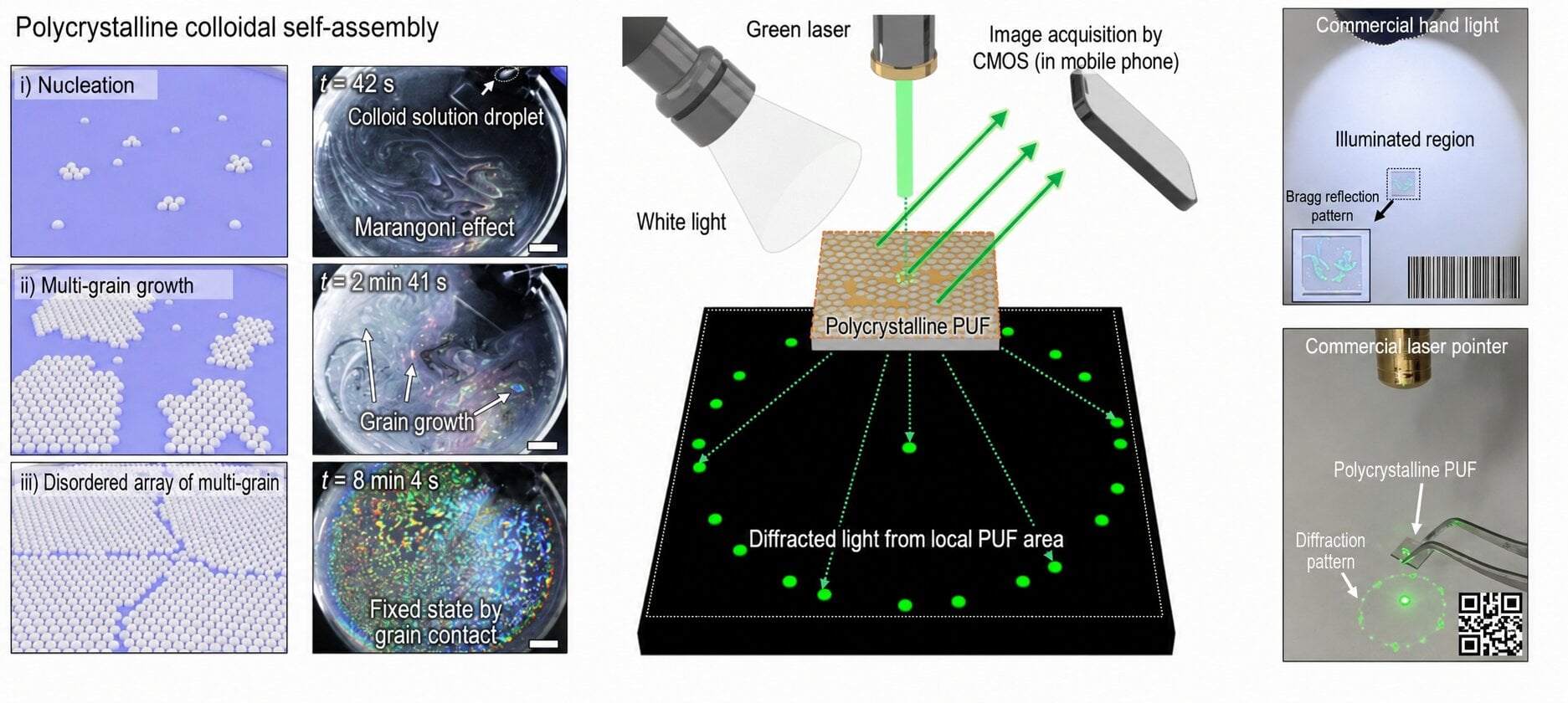
According to the KAIST team, the distinct microscopic fingerprints created by the randomly assembled colloidal nanoparticles can be validated with a smartphone flashlight and a laser pointer.
 Source: KAIST
Specifically, researchers are developing a physical unclonable function (PUF) technology that uses microscopic variations created during manufacturing as unique “artificial fingerprints” for security. Because the precise arrangement of particles is extremely difficult to replicate, the technology could be used to authenticate electronic devices and combat counterfeiting, offering an additional layer of security beyond conventional encryption.
By creating a nanofingerprint PUF that can be authenticated using ordinary light and a laser, the team eliminated the need for expensive and specialized microscopes or imaging equipment. Self-assembled nanoparticles form unique crystalline patterns that are difficult to reproduce. Each structure produces two distinct optical signatures — a color/reflection pattern under a flashlight and a light-scattering pattern under a laser. When comparing both signatures with registered patterns, the technology offers a two-factor approach for securely authenticating products and electronic devices.
As a result, counterfeiters would need to replicate not only the nanoparticle structure but also its color and reflection pattern under flashlight illumination and its unique optical pattern under a laser, making the technology nearly impossible to duplicate.
In the lab, the team demonstrated that the nanostructures can be transferred to plastics, metals, transparent films and hydrogels, expanding their potential applications. The technology could provide unique hardware IDs for electronics and internet of things (IoT) devices, as well as anti-counterfeiting labels for luxury goods, artwork and pharmaceuticals. Transparent versions could also serve as discreet security stickers that preserve a product’s appearance.
The technology is detailed in the article, “Dual-space visible light authentication toward high security physical unclonable function,” which appears in the journal Nature Communications.