Infrared filter promises more accurate pollution, disease detection
Marie Donlon | June 28, 2026A tiny, electrically tunable infrared filter capable of potentially shrinking bulky thermal sensing systems onto portable chips has been developed by a team from The University of Western Australia and The Australian National University.
With the promise of leading to the development of technology such as handheld pollution detectors, compact multispectral cameras and next-gen chemical sensing devices, the filter operates in the long-wave infrared region — otherwise known as the part of the spectrum linked with thermal radiation emitted by objects that are near room temperature.
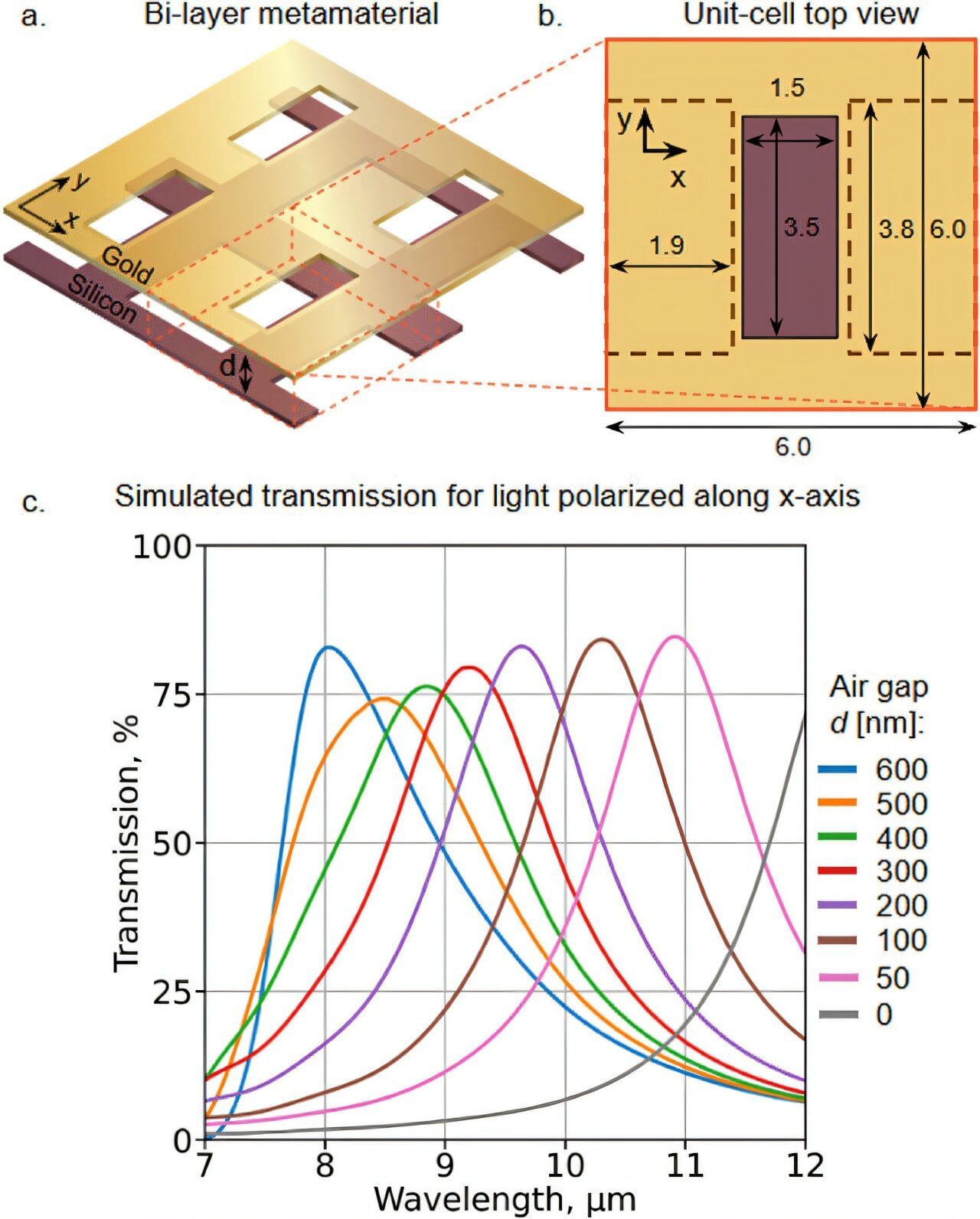 Source: Advanced Materials Technologies (2026). DOI: 10.1002/admt.202502605
The new device reportedly helps infrared systems distinguish between different materials and gases according to their spectral "fingerprints," rather than conventional thermal cameras that primarily measure heat intensity. The team described the system as being similar to "color vision" for thermal imaging.
"Instead of seeing only hot and cold, a camera could compare several carefully selected infrared bands, similar to how the human eye combines red, green and blue wavelengths to perceive color," the team explained. "That could allow systems to tell the difference between gases, chemicals or materials that look identical in ordinary thermal images."
The microscopic device is made of suspended gold and silicon membranes featuring nanoscale holes. By electrically adjusting the tiny gap between the layers by just a few hundred nanometers, the device can continuously tune which infrared wavelengths are transmitted, thereby enabling significant control of light with wavelengths around 10 microns.
Among the many potential applications for the technology are environmental monitoring tasks like detecting methane leaks and industrial emissions.
Likewise, the technology could also be used to identify materials associated with industrial safety, thermal imaging and defense systems.
The team also suggests the potential for medical diagnostics applications, with spectrally selective thermal imaging systems capable of detecting slight physiological changes not captured by conventional thermal cameras.
"The most realistic applications are noncontact diagnostics and advanced thermal imaging," the team noted. "Different tissues emit infrared radiation differently, so spectrally selective thermal imaging could potentially help identify inflammation, monitor wounds or detect subtle physiological changes invisible to standard thermal cameras."
The lightweight, low-power infrared sensors could also be appropriate for use in drones and portable field systems.
An article detailing the device, “Tunable Extraordinary Optical Transmission in the Long‐Wavelength Infrared Range Using Electrostatic MEMS Actuation,” appears in the journal Advanced Materials Technologies.