Strategies to optimize power in remote sensing networks
Andy Tomaswick | April 21, 2026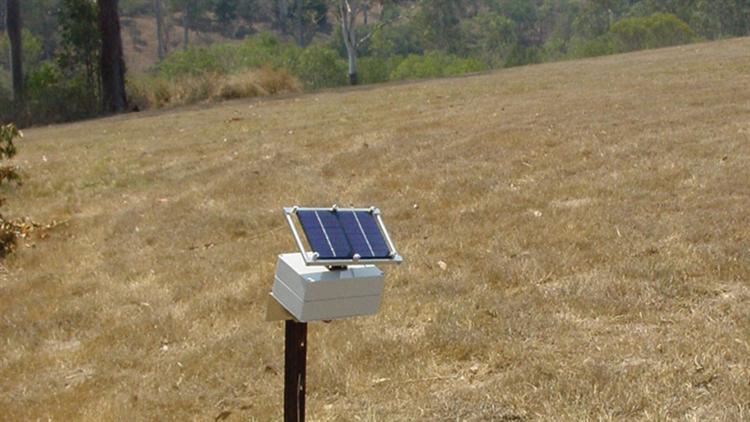 Example of solar-powered wireless sensor node at the CSIRO ICT Centre in Brisbane, Australia. The network monitors local climate for agricultural guidance. Source: CSIRO/CC BY 3.0
Remote sensing and its promise of a more efficient world is built on the idea of collecting data anywhere. Millions of devices are monitoring everything from deep-sea pipeline integrity to telemetry on microsatellites in low Earth orbit.
But these deployments inevitably collide with the hard limit of power management. The economic cost of a sensor is rarely the hardware itself, but the cost of ownership associated with the labor and materials to deploy it and, crucially, to keep it powered. Sensors can be located miles away from the nearest electrical grid or buried in sealed concrete foundations. In these cases, battery replacement is either impossible or impractical.
Overcoming this power roadblock requires a holistic design approach, not just a larger battery. Extending the lifespans of energy devices to five, 10 or even 20 years requires a combination of the energy sources and power management strategies, at both the hardware and firmware level, alongside optimized communication protocols.
It always starts with the battery
For the vast majority of remote instruments, non-rechargeable batteries remain the central component of power design. But not all chemical batteries are created equal, and when lifespans start stretching out to decades, considerations like self-discharge rates and temperature stability become just as important as raw energy density.
Lithium thionyl chloride (Li-SOCl2) batteries are the current gold standard for long-term remote deployments. Li-SOCl2 cells offer exceptional energy density with a self-discharge rate of less than 1% per year. Crucially, they can also operate in extreme temperature ranges from, -55° C to over 85° C.
However, they suffer from a phenomenon known as passivation: a resistive layer that forms over time on the lithium anode. While this film actually helps limit self-discharge, it can also cause severe voltage drops during high current draws, requiring careful capacitor buffering to keep the voltage up.
Another notable battery chemistry is lithium manganese dioxide. This is often seen in coin cells, like the ubiquitous CR2032. They’re extremely cost-effective for low-power, short-lifespan applications and handle pulse currents better than unbuffered Li-SOCl2 architectures, but have a higher self-discharge rate and a lower overall capacity.
Solid state batteries are slowly gaining interest in the commercial market as well. They replace liquid electrolytes with solid ceramics or polymers, and offer significantly advanced safety, low leakage currents and the ability to be packaged into customizable form factors.
Another emerging technology is the use of supercapacitors. Remote sensing usually operates in two distinct states defined by firmware: a deep sleep mode that draws microamps and an active transmission mode, where a microcontroller draws tens or hundreds of milliamps to send a wireless signal. Batteries struggled to deliver these sudden, high current pulses, which is exactly where supercapacitors can help.
Placed in parallel with a battery, the supercapacitor trickle charges slowly over the time that a system is in deep sleep mode, then delivers the rapid burst of power required for RF transmission when necessary. That extra power helps eliminate voltage sag and prevents the device from entering an unexpected brown-out reset.
Getting creative with power harvesting
Battery-only systems can never truly be “deploy and forget,” as they have a finite lifetime. Getting to a deploy and forget state requires energy harvesting: pulling ambient energy from the environment. With access to an ever-renewing source, devices can operate indefinitely, or at least until components begin to degrade.
Solar is the most well-known and mature of these technologies. Power grid applications are becoming commonplace around the world, but scaling it down to power an individual sensor comes with a whole different set of challenges. The most notable of which might be size. Solar panels need to be sized not just for peak sunlight, but also overcast days or when obscured by dust, snow and debris.
Thermoelectric generators (TEGs) are only somewhat less dependent on the outside environmental conditions. They rely on the Seebeck effect, where a temperature differential across a semiconductor generates a voltage. In some environments, like industrial plants or cars, TEGs can provide a highly reliable trickle charge. But in isolated locations, it can be hard to maintain enough of a thermal gradient to provide significant power to the hardware. Designers account for this with ever more elaborate heat sinks, but in hot environments, there is a decent chance a TEG's output would drop to 0 V.
For some specialized sensors, the application provides its own energy. Piezoelectric materials generate an AC current when subjected to mechanical stress or vibration. Tuning a harvester’s resonant frequency to match the dominant frequency of whatever it's monitoring allows this passive system to draw microwatts of power, eliminating the need for batteries entirely. However, they are only useful in environments where the substrate they are attached to is physically shaking at a relatively high frequency, which doesn’t happen very often in the natural world.
Radio frequency (RF) harvesting captures ambient electromagnetic waves and converts them into DC power. It has the advantage of being able to translate waves from common sources like Wi-Fi routers and cell phone towers. However, the technology is still in its infancy commercially, and the inverse square law of electromagnetic transmissions means the amount of power harvested is incredibly small, often in the nanowatt to low-microwatt range. This means, at least for now, RF harvesting is only suitable for ultra-low power devices that are situated very near an RF transmission source.
Putting power to good use with the right protocol
Sourcing power is only half the battle in remote sensing. What to do with that power makes up the other half of the decisions engineers must make when designing these systems.
The most effective way to save power is to do nothing. Hence, most remote sensing platforms have an extreme-duty cycling paradigm. A typical sensor might sleep for 59.9 seconds, then wake up for 100 milliseconds, take a reading, transmit that reading for another 100 milliseconds, then go back to sleep. In this architecture, the quiescent current draw of the hardware becomes the dominant factor in battery life. Since 99.9% of the time the sensor is asleep, a poorly chosen voltage regulator with a high leakage current could drain the battery faster than actual data transmissions. Component selection is key in this domain, and picking the right one can make the difference between the sensor being economically viable or not.
If the sensor is bi-directional, such as those that are able to perform firmware over-the-air (OTA) updates, it will occasionally have to turn on just to check to see if anyone is trying to talk to it. A new technology called a wake-up radio solves this problem by designing a second, ultra-low-power receiver that is always on but only draws nanowatts of power.
When it detects a specific RF signature, say a Gateway trying to ping the system, it triggers an interrupt that wakes up the primary, higher power transceiver that can figure out what to do with that incoming signal. This allows for asynchronous, low-latency communication.
Sending lots of data over a wireless communication protocol is also a massive power draw. New frameworks are moving much of the calculation of data to the “edge” — the sensor itself — to try to limit the amount of energy expended sending unnecessary data.
In this architecture, the sensor's microcontroller itself runs a lightweight algorithm on the data it has collected to determine if there was any anomaly that must be sent back to the main system. Transmitting a single boolean value (i.e., failure = “true”) requires orders of magnitude less energy than transmitting raw data every hour. However, the system will still need to check-in occasionally to ensure the connection between the sensor and its gateway hasn’t dropped.
Wireless communication protocol selection might be the most important factor in deciding the overall power architecture. Common protocols like Wi-Fi and 5G are designed for massive data transfer and are notoriously power-hungry. Luckily, there are several options for power-starved remote sensing applications. LoRaWAN is one of the most common. This medium-frequency protocol can travel miles in open terrain or even dense urban jungles. But it trades off battery life for bandwidth, it is ideal for transmitting small payloads, hence the interest in moving to edge networks.
NB-IoT and LTE-M, on the other hand, leverage existing cellular infrastructure but are optimized for internet of things (IoT) devices. They offer deep sleep states (like eDRX and PSM) that allow devices to disconnect from the network entirely for a period of time without having to perform power-intensive handshaking when they are reconnected. Another popular choice is Bluetooth low energy (BLE). It operates excellently as a mesh network, but lacks the range of other low-power wide-area networks (LPWAN) and is normally limited to a few hundred feet around the sensor.
Summary
Power management for remote sensing is one of the most critical parts of the design phase. It requires engineers to view their power budget as a non-renewable resource and manage the trade-offs and decisions that ultimately feed directly into the value of the sensor system.
Matching the right energy storage technology with the right harvesting mechanism and the right power management and communication protocols can have a huge impact on the final look, feel and operations of a remote sensing system. As all of these areas continue to improve, engineers will have spent their time continually learning about the latest and greatest technology to make sure their remote sensing applications can keep up with the pack.