Discarded oyster shells could help extract rare Earth metals from contaminated water
Marie Donlon | April 20, 2026Researchers at Trinity College Dublin have discovered an inexpensive and environmentally friendly approach for removing pollutants from water using oyster shells.
Although oyster shells would typically end up in landfills after consumption, the team determined that they can be used to capture and remove rare Earth elements from polluted water, turning them into stable mineral crystals.
 Source: Trinity College Dublin
Used in everything from wind turbines and electric vehicles to smartphones, the extraction and processing of rare Earth elements pose environmental risks when the metals leak into water systems. Likewise, rare Earth elements are at the center of growing geopolitical tensions, as global supply tends to be heavily concentrated in a few countries and demand for these materials continues to rise.
In the event that the rare Earth elements are released into rivers or lakes, they accumulate in aquatic ecosystems and disrupt microorganisms, plants and animals. As such, the team sought to develop sustainable ways to remove rare Earth elements from water.
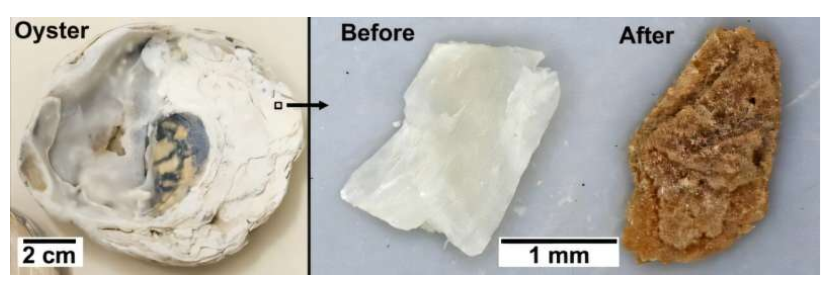
In the lab, the researchers exposed crushed shells — mussels, cockles and oysters — to solutions featuring rare Earth elements. Once exposed, the team determined that the shells triggered a chemical reaction wherein the minerals in the shell dissolved and were replaced by new minerals featuring the rare Earth elements. Ultimately, the shells behaved as a "template" that transforms dissolved metals into solid mineral crystals that are subsequently locked within the shell material.
Oyster shells proved to be the most effective material tested for removing rare Earth elements from contaminated water. This is because their porous structure enables chemical reactions to penetrate deeply, allowing for much higher metal capture versus other shells. Conversely, mussel and cockle shells instantly formed an impermeable surface layer that limited further reaction.
The team explained that the process works because calcium carbonate in the shells dissolved and was replaced by rare Earth carbonate minerals through a natural sequence of transformations. Oyster shells allow for this reaction to continue throughout the entire material, resulting in an almost complete conversion as well as a very high uptake — reportedly up to about 1.5 grams of rare Earth metals per gram of shell.
The researchers noted that this approach is inexpensive, environmentally friendly and requires minimal technology because it relies on natural mineral reactions. Given that aquaculture produces large amounts of discarded shell waste, repurposing it could both clean polluted water and recover valuable metals. The findings also suggest the potential for separating different rare Earth elements during the process, leading to sustainable recycling technologies.
The article, “Sustainable rare earth capture using seashell carbonates: Mineralogical pathways and comparative uptake behaviour of mussel, cockle, and oyster shells,” appears in the journal Science of The Total Environment.