
Hypersonic heat: Next-gen ceramics could solve re-entry ablation issues
Andy Tomaswick | March 12, 2026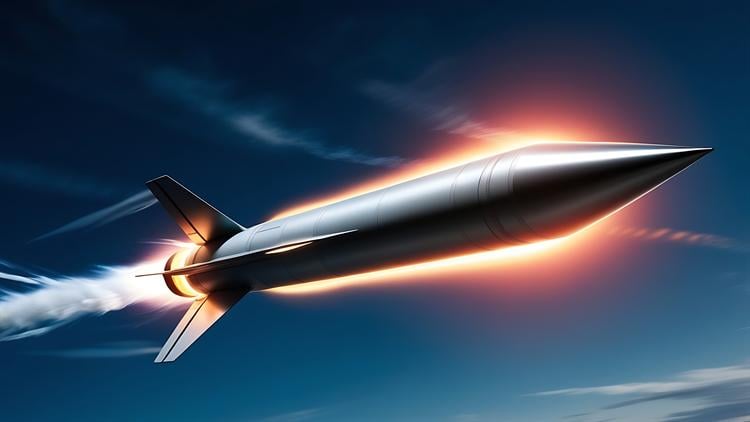 Source: MDFUAD/Adobe Stock
Aerospace engineers are constantly trying to push the boundaries of materials science. Flying at hypersonic speeds — defined as Mach 5 and above — is likely the toughest environment to engineer materials for. At these speeds, temperatures can reach beyond (1,727° C), straining even the most durable materials.
To survive those temperatures, aerospace engineers rely on advanced thermal protection systems (TPSs). The most common of those are carbon-carbon (C-C) composites. They offer ultra-low density, high thermal shock resistance and maintain their mechanical strength at temperatures that would liquify other advanced alloys.
Most famously, they were used in the heat shields of the Space Shuttles, which had to withstand the forces of atmospheric reentry. They are also needed for the competing hypersonic missile programs of several world power militaries. These are high speed, high manueverability weapons that leave Earth's atmosphere to strike faraway targets, similar to ICBMs.
But, TPSs have several weak points, and a recent graduate thesis from Alin Ilie Stoica of the University of Notre Dame digs into what actually causes those issues, and suggests some potential fixes for future designs.
Mach 5 materials
When a carbon-based heat shield is subjected to hypersonic atmospheric re-entry it experiences ablation, a process where the material absorbs and dissipates heat through phase changes, chemical reactions and most importantly, material loss. Ablation is a great way to remove heat from directly interacting with a vehicle, although it does so by sacrificing the heat shield material, which results in changing aerodynamic profiles and often requires replacement of the heat shield itself, adding expense before the spacecraft can be used again.
Stoica tested that ablation process in Notre Dame’s ND_ArcJet ground-based wind tunnel, simulating Mach 6 air and nitrogen flows around several samples of C-C composites. To ensure the most accurate test conditions, the samples were also pre-heated with a laser up to 1,727° C before they were subjected to the wind. After capturing as much data as possible with a combination of high-speed Schlieren imaging, infrared thermography and even scanning the leftover material with a scanning electron microscope, it became obvious that there were three main causes of ablation of the material, but one stood as more important.
First there is sublimation, the cause with the least ablative effect, where the solid carbon of the heat shield directly sublimated into a gaseous state. It contributed a small measurable percentage of the overall ablation of the material.
Spallation was the next most significant factor, accounting for around one-third of the material loss during the experiments. This process happens when the wind shear of Mach 6 fragments material away from the material surface. Typically, this is preceded by some delamination of the composite, caused by the most prolific of the three causes of ablation: oxidation.
Oxygen atoms can penetrate the matrix of carbon atoms in the composites, reacting with them to form carbon dioxide and carbon monoxide. The creation of these gases rapidly hollows out the structure, while also creating microcracks that spallation can then rip material away from. This process accounts for almost two-thirds of the material loss during a reentry event, making it by far the biggest contributor to that process and the first challenge to adding multi-use resilience to TPSs.
One of the biggest takeaways from the research is that the orientation of the carbon fibers in the composite is influential. Not only does it matter for oxidation, but it also matters for thermal energy flows. In C-C composites, thermal energy flows very efficiently along the longitudinal axis of the carbon fibers, but not very well across the gaps between the fibers themselves. Notably, according to the results shared in the thesis, there is a significant drop in thermal conductivity and diffusivity once the material’s temperature reaches past 1,727° C. At these high temperatures, phonon scattering disrupts the thermal energy transport, and makes the material much less effective.
Thermal changes aren’t the only one C-C composites have to deal with though; the amount of structural degradation is dramatically dependent on fiber orientation. In an orientation where fibers run parallel to the hypersonic flow of gas, the ablation rate is high, measured at around 12.5 g/s-m2. This is because the gaps between the fibers act as conduits for the oxidizing gas to enter the structure of the composite, allowing oxidation to take root deep within its structure.
Comparatively, when the fibers are oriented perpendicularly to the flow of gas, the ablation rate drops by 50% to around 8.4 g/s-m2. In this case, it's harder for the gas to press through the long fibers, but those same fibers also trap the gas from the oxidative particles that do get in near the surface, choking off supply of fresh oxygen to the underlying carbon matrix.
The research also compared the ablation rates of another type of material known as extruded graphite, which has similar characteristics to the perpendicular C-C composite structures. This material, which is composed of a uniform microstructure and lacks noticeable fibers, provides a strong interface that resists mechanical spallation, but doesn’t hold on to blocking gases released from the oxidation process as well as the perpendicular C-C composites do.
The SiC dilemma
Since C-C composites suffer from so much oxidation, the current best technique is to layer them with a protective coating. Silicon carbide (SiC) has become the industry standard for this application, and a quick look at the results from the thesis shows why. Coating with SiC can reduce the oxidation rate of C-C composites by at least 50% by providing a viscous silica layer at high temperatures that acts like a physical barrier to oxygen diffusion.
However, that same reaction that produces the silica layer also generates internal carbon-monoxide gas. As the temperature surrounding the layer rises, the pressure from those gases inflates them into microscopic blisters in the coating. At high sheer speeds of hypersonic flight, those blisters can burst, creating a direct path to the underlying C-C composite and exposing it to rapid oxidation. That process has left engineers searching for other solutions and they might have found some in the ceramics world.
Next-gen TPSs
While C-C composites are the industry standard for right now, researchers are looking for replacements that don’t suffer from the same ablation difficulties. They believe they found some in ultra-high temperature ceramics (UHTCs) and ceramic matrix composites (CMCs). These materials boast melting points of above 3,000° C and don’t oxidize in the same way C-C composites do. Instead, they form highly stable, refractory oxide scales that don’t generate disruptive outgassing.
The manufacturing of these processes is also undergoing a revolution, with power and time intensive processes like chemical vapor infiltration and polymer infiltration and pyrolysis used to create C-C composites being replaced by laser sintering systems that can produce the same quality materials in a fraction of the time. There’s even a push to adopt 3D printing technology for hybrid thermoplastic composites and polymeric ablators, such as the phenolic impregnated carbon ablator (PICA) currently used by both NASA and SpaceX.
With these processing systems, engineers can intentionally design in air chambers and dynamically vary the porosity of the material. This allows them to tailor the thermal properties and density of material to the aerodynamic load of a specific vehicle, which is infeasible for generic solutions like traditional C-C composites.
Learning from failure
Hypersonic flight, and especially spacecraft reentry, is once again gaining prominence due to demand from both commercial and military organizations. As engineers test the new types of materials for these systems, they are beginning to open the possibility to even faster flight within Earth’s atmosphere than ever before, while also lowering the cost of access to space by eliminating the need to completely replace the TPS every time it goes through reentry.
With the integration of UHTCs, strategic fiber placement, new coating materials and the utilization of 3D printing, the development of these highly engineered systems looks set to truly take off soon.



This is Terrific we had developed ceramic matrixed materials when we were developing NASP Mach 25. This matrixed materials was shifted into Armor plating in the FCS.