Fungi turn leftovers into lifesaving resources
Marie Donlon | March 22, 2026In a bid to find new ways to feed people, a team of Cornell University food science researchers are eyeing networks of fungi to transform agricultural waste into food.
Specifically, the team is focused on an "emerging circular fungal biorefinery," which is a system wherein low-value agricultural byproducts are converted via fungal fermentation into high-protein, nutrient-rich foods.
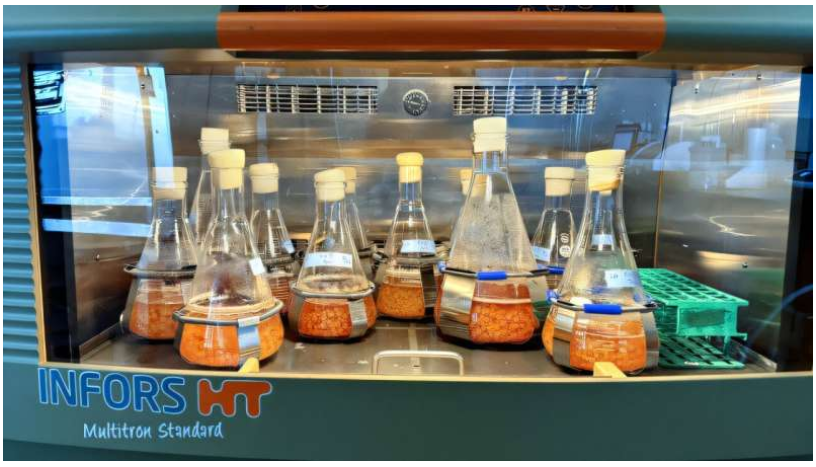 Various mixing regimes affected mycelium spore pellet formation, some producing larger, flocculent pellets and others compact, elliptical ones, both shown here in experimental flasks. Source: Cornell University
"The main driver of this type of research is identifying new and sustainable food sources," the team said. "We looked at all the possible perspectives and tried to understand the technologies and the research gaps."
The team sought to identify products that could potentially be extracted or produced via precision fermentation, drawn from waste streams in agriculture, food processing and manufacturing or household waste.
Fungal fermentation has the potential to upcycle low-value agricultural and food wastes into nutritious, sustainable foods. Yet this relies on integrating advanced processing technologies and discovering ways to enhance yield, functionality and product quality.
Fungi — which are commonly used in foods like tempeh, miso and cheese, and already found in products like Quorn — are now entering a new phase in food innovation. Advances in biotechnology now enable scientists to modify fungal growth and thus enhance their nutritional output.
The Cornell team suggests fungi should be seen not just as alternative protein sources, but as biological engines capable of transforming agricultural residues, food-processing byproducts and other organic waste into sustainable meat analogs and functional foods. Specifically, materials such as mixed green waste and fruit pomace, when pretreated, can potentially serve as nutrient-rich feedstock for fungal cultivation.
The team highlighted fungi’s efficiency in converting complex biomass into structured proteins. In addition to high protein content, fungi provide minerals and bioactive compounds, making them a potential nutritious substitute for animal-based protein.
An article detailing the findings, “An emerging biorefinery of mycelial food products from sustainable feedstocks,” appears in the journal Trends in Food Science & Technology.