Direct lithium extraction: Revolutionizing the lithium supply chain
N. Mughees | March 04, 2026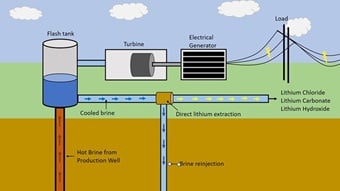 A schematic of lithium extraction from geothermal brines. Source: LazerRocDoc/Wikimedia Commons
Lithium is a critical element underpinning modern battery technologies, and demand for it has surged with the rise of electric vehicles and energy storage systems. Traditional lithium production from brines relies on expansive solar evaporation ponds and lengthy processing times — often 12 to 18 months of waiting for water to evaporate. This conventional method is effective but constrained by climate, consumes vast land and water, and struggles to rapidly scale output.
Addressing the increasing demand necessitates more than merely extracting additional lithium. It needs more intelligent and sustainable methods for its extraction. Introducing direct lithium extraction (DLE) — an innovative technology that provides a more rapid, environmentally friendly and economically viable alternative to conventional methods. This article will explain the concept of DLE, its significance and its potential to transform the future of lithium production by saving energy and water usage.
How DLE works
DLE methods employ sophisticated adsorbents, membranes or solvent-based systems to precisely isolate lithium ions. By particularly targeting lithium, these technologies minimize contaminants and facilitate the manufacture of high-purity lithium compounds appropriate for direct application in battery manufacturing. The outcome? Reduced production expenses and a more environmentally friendly, efficient procedure.
These technologies are typically classified into three primary categories:
Adsorption-driven DLE
This method captures lithium ions by adsorbing them onto the surface of a selected sorbent material. Lithium is subsequently extracted from the substance utilizing chemicals or water. Adsorption-based direct lithium extraction has demonstrated significant potential in effectively recovering lithium from brines.
Ion exchange-based DLE
The process entails the exchange of lithium ions for cations within the framework of a sorbent material. The procedure necessitates an acidic solution to extract and reclaim the lithium. Ion exchange-based DLE methods exhibit the capability to efficiently extract lithium from complicated brines with elevated concentrations of diverse ions by exchanging lithium ions with other ions in the solution.
Solvent extraction-driven DLE
Solvent extraction supports the migration of lithium ions from brine into an organic liquid phase that contains a specific extractant. This extractant forms compounds with lithium, facilitating the selective recovery of lithium from complicated brines while ensuring high purity.
Energy and water use considerations
A major driver for adopting DLE is the potential for a much smaller environmental footprint in terms of water and land use. Traditional evaporation in salt flats, such as in the Atacama Desert, results in significant water loss — roughly 100 m3 of brine water are evaporated to produce one ton of lithium carbonate equivalent (LCE). This represents water that is permanently removed from the local hydrological system, raising sustainability concerns in arid regions. DLE processes aim to drastically reduce this water consumption. By reinjecting the spent brine back underground, DLE can cut net water loss by orders of magnitude. In fact, DLE with reinjection has been reported to use as little as ~2 m³ of water per ton LCE, 50 times less water than the evaporative method in Chile.
However, it is important to consider freshwater inputs and energy use as well. Some DLE technologies require fresh water for certain steps — for example, to wash sorbents or to make chemical reagents for stripping and precipitation. If not carefully optimized, a DLE plant could still consume significant volumes of fresh water (even if brine water is largely returned). This is a potential issue in water-scarce areas, and ongoing research emphasizes the need to quantify and minimize freshwater use in DLE. Many developers are working on water-balanced flowsheets, where brine itself (a salty solution) is used for most process needs, and any freshwater use is kept to a minimum or fully recycled.
Energy consumption is an additional trade-off between DLE and evaporation. Evaporation ponds utilize solar energy over extended periods, which is costless although very gradual. DLE, in contrast, expedites the process by introducing energy through pumping power, heat or electricity for chemical reactions. For instance, operating pumps to circulate brine through columns and membranes require electricity; thermal renewal of adsorbents need heat (perhaps sourced from gas or electricity); and electrochemical processes such as electrodialysis demand power. The carbon footprint of DLE is contingent upon the energy source; when utilizing renewable energy or waste heat, DLE may present a low-carbon solution, whereas reliance on fossil fuels could lead to substantial emissions. The industry is acutely cognizant of this and, in certain instances, is co-locating direct lithium extraction activities with renewable energy or harnessing geothermal heat from the brine itself.
Conclusion
DLE uses advanced materials science and chemical engineering — from selective adsorbents to sophisticated membranes — to pull lithium from brines with unprecedented speed and efficiency. The result is a process that can deliver more lithium, faster and with a smaller environmental footprint in water-starved regions. For industry professionals, the promise of DLE is not just in the technology itself, but in its ripple effects across the lithium supply chain. It enables a shift from sprawling, slow operations to agile, scalable production that can be situated in diverse locales and integrated with existing industrial processes. This could translate into a more secure and responsive supply of lithium, helping to meet booming demand without the bottlenecks and sustainability pitfalls of the past.