Study: Insect farming byproduct boosts soils while reducing crop losses
Marie Donlon | February 20, 2026A team of researchers from the Arkansas Agricultural Experiment Station at the University of Arkansas suggests that the insect farming byproduct “frass” improves soil health and reduces insect damage in soybean crops.
The team is eyeing insect frass — which is a mixture of manure, an insect’s molted skin and leftover insect food — to help with insect farming, which is forecasted to produce millions of tons of insects in the coming years for the purpose of feed for fish, swine and pet food, and human food in energy bars, among other use cases.
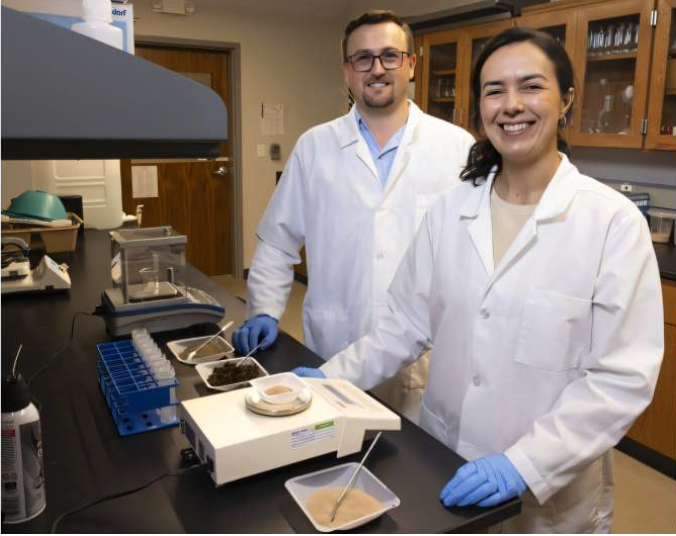 A team of University of Arkansas researchers investigated the impact of insect waste as a soil amendment in soybeans and switchgrass. Source: University of Arkansas
"For every 1 pound of insect meal, you get up to four times more frass, so the question came up whether it could be used as a soil amendment," the researchers wondered.
To answer that question, the team looked specifically at black soldier fly frass as a soil amendment in soybean and switchgrass fields with the trials reportedly revealing that the frass worked as well as chicken litter, even when applied in lower amounts.
Further, the team believes that there are plant-growth-promoting beneficial microbes present in the frass that are not available with poultry litter. Specifically, when used as a soil amendment in soybean plots, frass reduced leaf damage from insect pests by 38% to 45% when measured against control plots and soybeans grown with poultry litter.
An article detailing the findings, “Recycling waste via insect agriculture: Frass impacts on soil and plant health,” appears in the Journal of Environmental Quality.