How automated identification is transforming materials handling
Jody Dascalu | March 02, 2026Automated identification in materials handling must operate across variable package orientation, materials and flow conditions in high-throughput conveyor and sortation systems. In these environments, identification performance depends on how well these variables are handled at the system level rather than on any single sensor.
Barcode systems degrade when labels rotate, become occluded or wear during handling. Early RFID deployments removed the need for line of sight but introduced sensitivity to orientation, package contents and RF interference from surrounding equipment. Modern designs address these effects by measuring signal strength and phase across multiple tags and reader angles, allowing systems to infer orientation, select reliable reads and improve screening confidence without reducing throughput or replacing existing infrastructure.
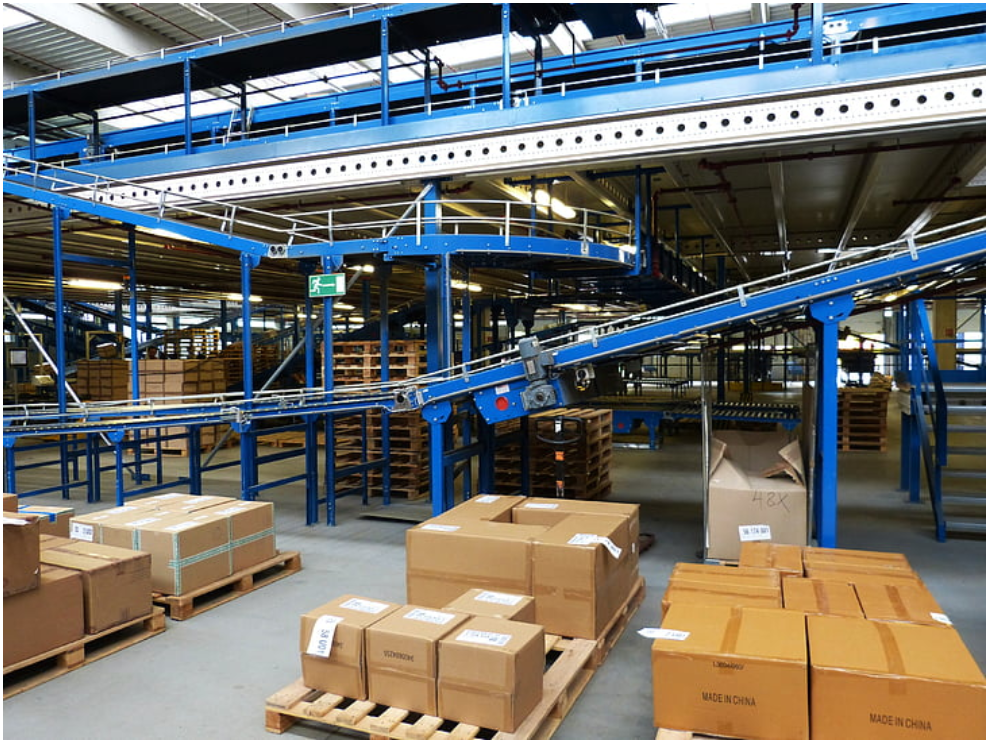 A warehouse conveyor system handling palletized boxes. Source: PickPic
RFID orientation as a system design constraint
Orientation-related read failures in RFID systems are driven primarily by how readers are positioned relative to package motion, not by limitations of the tags themselves. In conveyor and sortation environments, packages rotate, tilt and stack unpredictably, which places tags in a wide range of orientations as they pass through fixed read zones. Some of these orientations inherently couple poorly with the reader field and reduce read reliability.
Reader geometry determines which orientations succeed. Linearly polarized antennas perform well when tag alignment is favorable but fail when tags rotate out of plane. Circular polarization improves tolerance to rotation but reduces effective range. Systems that use multiple antennas positioned around the conveyor reduce dependence on any single orientation by increasing the likelihood that at least one antenna achieves sufficient coupling during a pass.
Modern RFID systems account for this variability directly. Instead of assuming every tag must read on every pass, system design model orientation effects across expected package motion and use redundancy and software logic to select the most reliable reads. This approach treats orientation as a predictable system variable and supports consistent identification performance under real operating conditions.
Material detection as a contextual layer
Orientation-aware identification improves read reliability, but it does not address whether package contents match the associated identity. Material detection extends identification by using RF signal behavior to evaluate what the signal passes through, not just whether a tag is present.
As RF energy interacts with package contents, signal strength and phase shift in ways that correlate with material properties. Absorptive materials reduce signal magnitude, conductive materials introduce reflections and instability, and mixed contents alter signal paths in consistent patterns. These effects are not treated as noise. They provide context that distinguishes lightweight, dense and metallic contents under normal conveyor motion.
When combined with orientation-aware tag selection, material sensing allows systems to validate declared contents and detect anomalies using the same RFID infrastructure. This enables content-aware screening and exception flagging without additional sensors, added dwell time or changes to conveyor operation.
Software-driven compensation and adaptive intelligence
Software plays a central role in compensating for variability that cannot be eliminated through hardware alone. Read confidence scoring allows systems to weight tag measurements based on their expected reliability instead of treating all reads as equal. When orientation inference indicates that a tag is poorly positioned, its measurements are downweighted, and system logic can defer to better-positioned tags or route the package for secondary screening.
Machine learning models extend this compensation by extracting patterns from signal strength and phase data that remain informative even when measurements are incomplete or noisy. Instead of relying on fixed thresholds, these models learn how signal behavior changes under realistic operating conditions that include interference, nearby tags and variable distances. This allows material inference to remain stable across a wider range of package configurations.
Anomaly detection adds a final layer of control by comparing expected and observed signal behavior. When tag identity and material response diverge, the system flags an exception even if the material cannot be classified with high certainty. This enables detection of mislabeling, substitution and concealed contents without requiring precise material identification on every package.
Operational impact and system performance
Integrating orientation-aware identification with material sensing improves screening reliability without reducing throughput. By selecting more reliable tag reads and adding material context, systems reduce uncertainty during primary screening rather than pushing it downstream to manual review.
As automated read consistency improves, manual exception handling decreases. Fewer unread or ambiguous packages reach exception stations, which lowers labor demand and reduces congestion in high-volume facilities. Even modest gains in first-pass read performance produce noticeable improvements in overall flow stability.
Compliance and traceability benefit from evaluating identity and material response within the same read cycle. Packages that align with expected content profiles continue through the system, while anomalies are routed to secondary screening. This separation occurs without additional dwell time, allowing facilities to improve screening coverage while preserving operational pace.
Implementation and future direction
Enhancing existing facilities does not require full system replacement. Incremental upgrades such as adding multi-angle antennas, enabling phase data capture in readers and deploying local processing allow legacy installations to improve performance with minimal disruption. Targeting areas with high exception rates provides the most immediate operational benefit.
Supporting software-driven systems requires collecting signal data across normal operating conditions, including variations in orientation, materials and environment. Early deployments typically apply conservative decision thresholds that route uncertain cases to manual review. As models are trained on site-specific data, thresholds can be adjusted to increase automation without compromising reliability.
Near-term system development focuses on adaptive behavior and integration. RFID environments are beginning to adjust reader configuration based on live performance metrics, and standardized interfaces simplify integration with complementary sensors such as vision and weight measurement. Material classification will continue to shift from fixed rules toward data-driven models, with adoption driven by application requirements and available training data.
Outlook
Package screening systems are moving toward adaptive, software-driven operation, but progress is incremental and tied to existing infrastructure. Orientation-aware RFID and material sensing improve identification reliability within current conveyor and sortation environments.
Effective system design treats orientation and material interaction as predictable inputs rather than isolated sensor limitations. Incorporating material context strengthens screening decisions without adding dwell time, while software-based compensation improves performance under variable operating conditions.
Deployment choices remain facility-specific. Error patterns, throughput targets and acceptable exception rates determine how these techniques are applied and where they deliver the greatest operational value.