'Leaf' it to science: Faux foliage pummels pollution
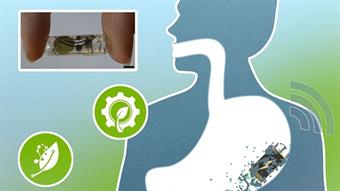
Cari Cooney | November 07, 2025 Artificial leaf. Image source: University of Cambridge
A research team led by the University of Cambridge is rethinking how this crucial industry runs, aiming to “de-fossilize” it for good. Their latest breakthrough is a clever hybrid: light-catching organic polymers teamed up with bacterial enzymes to turn sunlight, water and carbon dioxide into formate: a clean fuel that can drive the next wave of chemical reactions.
This "semi-artificial leaf" works on its own power and copies photosynthesis, which is how plants turn sunlight into energy. The current biohybrid model is different from earlier ones since it uses non-toxic ingredients, works more effectively and stays stable without any extra additives.
Scientists successfully used sunshine to turn carbon dioxide into formate in the lab. They then employed it directly in a "domino" reaction to make a useful molecule used in medicine, getting both a high yield and a high purity.
[Read more about breakthroughs in air quality technology on GlobalSpec.]
Findings recently published in Joule say that this is the first time organic semiconductors have been used as the light-capturing part of a biohybrid system. This opens the door for a new generation of eco-friendly artificial leaves.
The chemical industry is still a key part of the world economy. It creates a wide range of products, including medications, fertilizers, plastics, paints, electronics, cleaning products and personal care items.
“If we’re going to build a circular, sustainable economy, the chemical industry is a big, complex problem that we must address,” said Professor Erwin Reisner from Cambridge’s Yusuf Hamied Department of Chemistry, who led the research. “We’ve got to come up with ways to de-fossilize this important sector, which produces so many important products we all need. It’s a huge opportunity if we can get it right.”
Reisner's research group focuses on making artificial leaves that can make carbon-based fuels and chemicals from sunlight without using fossil fuels. But a lot of their old designs use synthetic catalysts or inorganic semiconductors, which can break down quickly, waste a lot of the solar spectrum or have harmful chemicals like lead in them.
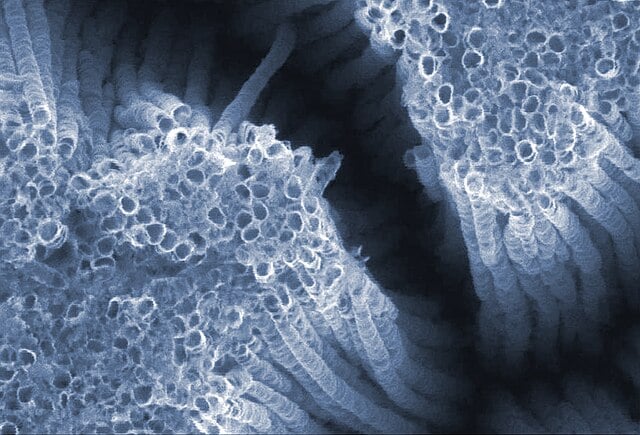 Titanium magnified showing nanotubes during lab prep. Image: Argonne National Laboratory
Dr. Celine Yeung, who worked on the research as part of her PhD studies in Reisner's lab, said, “This device combines the best of both worlds — organic semiconductors are tuneable and non-toxic, while biocatalysts are highly selective and efficient.”
The innovative device combines organic semiconductors with enzymes obtained from sulfate-reducing bacteria to break water down into hydrogen and oxygen or turn carbon dioxide into formate.
The researchers have also solved a long-standing challenge: most processes require chemical additives, called buffers, to keep the enzymes operating. These may break down quickly, which makes things less stable. The researchers made the system function in a basic bicarbonate solution, like sparkling water, by adding a helper enzyme called carbonic anhydrase to a porous titania structure. This meant that the system didn't need any additions that would make it hard to keep going.
“It’s like a big puzzle,” said co-first author Dr. Yongpeng Liu, a postdoctoral researcher in Reisner’s lab. “We have all these different components that we’ve been trying to bring together for a single purpose. It took us a long time to figure out how this specific enzyme is immobilized on an electrode, but we’re now starting to see the fruits from these efforts.”
“By really studying how the enzyme works, we were able to precisely design the materials that make up the different layers of our sandwich-like device,” said Yeung. “This design made the parts work together more effectively, from the tiny nanoscale up to the full artificial leaf.”
Researchers want to improve their designs so that this device lasts longer, but can also make other kinds of chemical compounds.