A better understanding of dust explosions
Seth Price | September 29, 2025Combustible dust explosions are a major threat to many manufacturing operations, such as milling of agricultural products, sawmills, plastic manufacturing and others. In a combustible dust explosion, fine powders are dispersed in a contained vessel and then ignited. The ensuing fireball can expand fast enough to generate a shockwave, where a shockwave is the characteristic feature of an explosion.
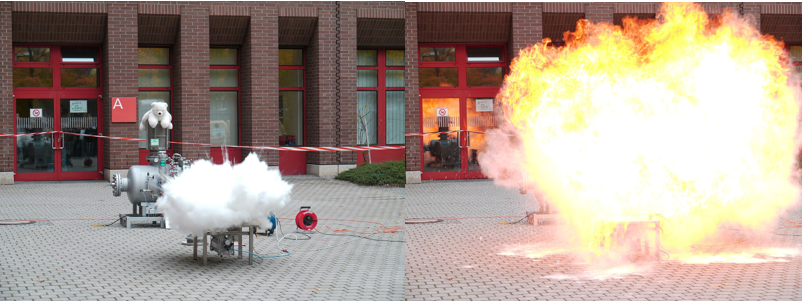 Dispersion of dust (left) and its ignition (right) with very little containment. Source: CC-BY-SA-3.0
To address the threats, the U.S. Occupational Health and Safety Administration (OSHA) has developed a set of standards related to preventing combustible dust explosions. These provide industry and material specific guidelines for handling potentially explosive dusts and powders. The U.S. Chemical Safety Board (USCSB) also points to numerous case studies and makes recommendations for dust management.
What is combustible dust?
While there are some caveats, if it is flammable and grown finely enough, almost anything can become a combustible dust. Chemically, the oxidation (burning) of a material happens on the surface; and a finely ground material has more surface area than a block of material.
There are five key ingredients to a dust explosion: combustible dust, confinement, dispersion, an oxidant (typically oxygen in the air) and an ignition source. The combustible dust pentagon helps visualize these components.
 The combustible dust pentation. If any component is missing, a dust explosion is highly unlikely. Source: CC-BY-SA-3.0
At first glance, dispersion and confinement seem like opposites. A powder that has been compressed into a cake is less likely to ignite than one dust that has been dispersed into the air. A dispersed powder exposes more surface area to both an ignition source and the oxidant.
Containment factors into the equation by allowing pressure to build. After ignition, the material rapidly heats and expands. If the material is trapped in a sturdy container, the pressure rises and causes the container to fail, and this failure can create a shockwave. Consider gunpowder; placed on a table and ignited, it will burn quickly but will not generate a shockwave. Place it in a metal pipe with the end caps, and it is, by definition, a pipe bomb, complete with a shockwave and shrapnel upon detonation. The same is true with any combustible dust.
The most common oxidant is oxygen present in the air. However, oxidizers, such as hydrogen peroxide, can supply the oxygen required to initiate the explosion.
Just like flammable vapors, the general rule of thumb is that if there is combustible dust, it will find an ignition source. Overheated conveyor bearings, static discharge, gas-fired burners, hot engines and many other sources have led to disastrous explosions.
Hazards
The initial hazard is the fireball and shockwave from the combustible dust once it finds an ignition source. However, these alone do not account for all of the casualties and property damage from a dust explosion. Often, the shockwave itself lofts more dust into the air and secondary and tertiary explosions are possible. In some cases, the initial explosion was small, but enough to shake loose more dust elsewhere in the facility.
One tragic example of how secondary and tertiary explosions work is the sugar dust explosion at Imperial Sugar. An overheated bearing set off a small explosion along a conveyor in a closed packaging line. That explosion knocked much more sugar dust loose from ductwork, pipes, light fixtures and other locations along the open ceiling. This also ignited with more force than the initial explosion; enough force to buckle the concrete floors, collapse stairwells and destroy the structure of the building entirely.
In this and many other similar cases, escape routes were damaged, power was lost and firefighting water lines were severed. From there, material that caught fire in the initial fireball continued to burn, igniting small pockets of collected dust as well.
Commonly affected industries
Any process that generates dust is susceptible to dust explosions. Historically, the highest risk has been in food (milling and drying of grain), mining, sawmills, paper production, pharmaceuticals, paint and dye operations, plastics manufacturing and many others. Grain silos and dryers were particularly dangerous and somewhat challenging to track, as they were often considered “agricultural” deaths. Coal mines were also a problematic industry, as explosions could be due to igniting pockets of methane or coal dust, and the cause was not always fully investigated.
However, even small amounts of grinding, polishing, spray drying, sawing, etc. can lead to dangerous dust accumulations. Sometimes smaller operations are more at risk, because they do not have the oversight to manage dust, and do not have a comprehensive training program to manage dust accumulation. Untrained operators may use compressed air to clean dust from surfaces, dispersing in the working area.
Prevention and mitigation mechanisms
Combustible dust is a fact of life in many industries. Cutting, milling, grinding and other such operations will always produce the dust that can lead to explosions and conflagrations. However, knocking out any piece of the combustible dust pentagon will reduce the chances of an incident.
One of the easiest methods is to limit the dispersion of the dust. Vacuum systems that transport the dust and collect it safely reduces its chances of finding an ignition source. Water sprays can be used in some operations to prevent dust from becoming airborne.
Routine maintenance procedures that remove dust are also important. Consider any place where a fine dust settles; light fixtures, in open ceiling panels, ductwork, on pipe surfaces and many others. If there is visible dust, it is enough for a dust explosion.
Mitigation techniques can reduce the damage of an initial dust explosion. The fatalities at grain silos have drastically decreased over the past few decades due to flash arrestors between silos and strategically placed blast doors that direct the energy in a safer location. Remove the containment leg of the pentagon, and the blast will not be as severe.
Some powder processing is performed in inert gas environments, such as nitrogen or argon. With no oxygen, the oxidant part of the pentagon is missing. However, inert gases have their own risks, and it is not a catch-all solution.
Overall, the removal of any leg of the dust explosion pentagon can drastically reduce the risk of a dust explosion. Proper placement of pressure relief valves, blast doors and other mitigation components can decrease the damage in an explosion. As shown, it is of critical importance to weigh options on how to best mitigate the chances of dust becoming more than a nuisance.