
How the wind can fuel AI centers
S. Himmelstein | August 01, 2025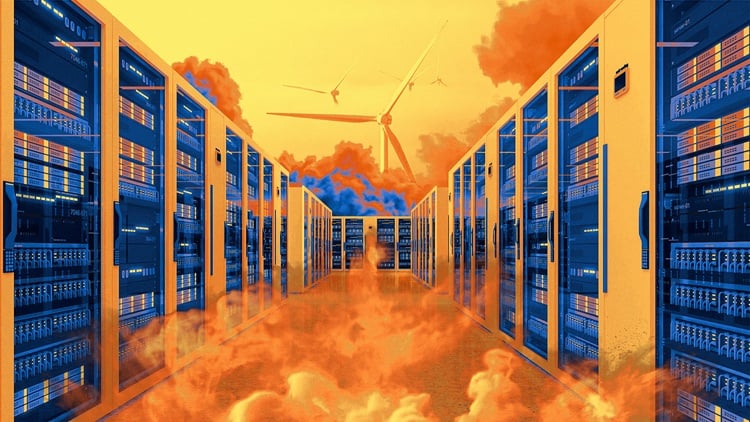 Source: Oselote/Getty Images
The steady increase in artificial intelligence (AI) workloads and data center thirst for more power can be supported by siting AI compute centers with renewable energy systems. An approach proposed by Microsoft Research envisions shifting large-scale AI inference — the process by which machine learning models draw conclusions from new data — to modular data centers co-located with wind farms to bypass overtaxed electric grids and exploit abundant, underutilized green energy.
More than six million high-end graphics processing units (GPUs) could be situated at wind farm sites to tap into low-cost green power at its source. A critical element of this so-called AI Greenferencing scheme is Heron, a new cross-site software router designed to efficiently manage the variable nature of wind power by dynamically routing workloads across distributed compute clusters.
By co-locating compute with energy sources and leveraging Heron to route tasks based on real-time power availability, developers can seize the opportunity to appropriately size and configure GPU deployments in order to meet user needs in regions where AI demand outpaces grid capacity.
The study published in arXiv Computer Science confirms that wind energy input defined by Heron improves aggregate goodput of AI compute — ratio between delivered amount of information and the total delivery time — by up to 80% compared to the state-of-the-art.



Co-location sounds like an interesting concept. Sounds like they are planning to handle the variability of the wind by routing the power to the areas where it is needed--where the wind generation has fallen off. Since these sites can be many miles apart, it seems this would require development of some sort of distribution ability. Maybe like today's ROWs, transmission towers, etc, that they are trying to eliminate. I'm interested in seeing how they plan to accomplish this.