Civil engineering marvels that will shake your foundation
Grace Watson | July 08, 2025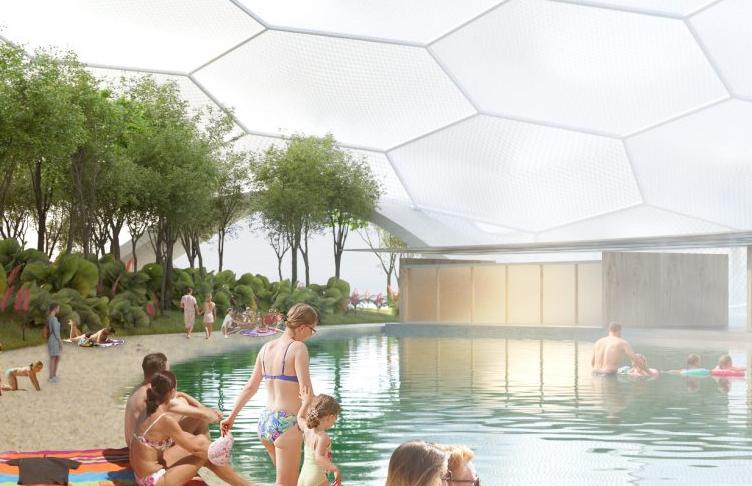 Hot Heart concept design. Image source: CRA
Civil engineers, one of the oldest professions on record, are tasked to utilize their skills and knowledge to create smart infrastructure for the public. Throughout the years, civil engineers have often used their expertise and creativity to design some otherworldly and remarkable projects, especially when budgets are ample enough to allow truly ambitious creations.
Below are four projects that leave even the most seasoned CE's in awe. One has been implemented for decades; the others are theoretical and conceptual to this day, but interest or research persists to try something different. Their unique designs and fascinating builds can power society in new ways, reach new heights, and allow us to traverse the world easier than ever before.
The Magic Roundabout
The magic roundabout can be described as an “adventurous piece of engineering.” It was designed by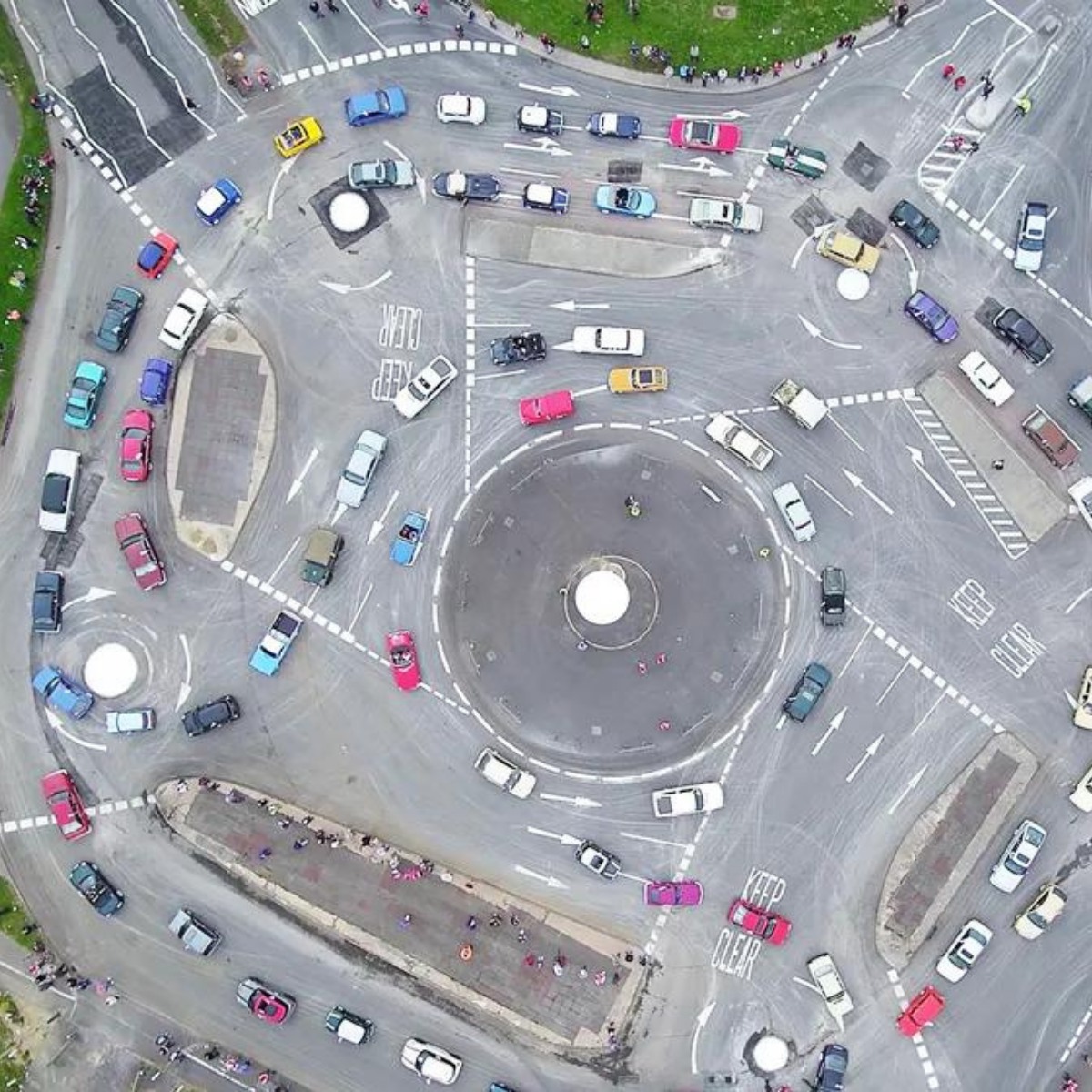 Think of it like a roundabout island...in the middle of 5 other roundabouts. Image source: BBC Frank Blackmore in 1972. He was a Royal Air Force officer and spent two decades working for the Transport and Road Research Laboratory in the U.K. The roundabout is a series of five roundabouts that are situated around a center roundabout. Traffic is allowed to flow both clockwise and counterclockwise in the center and clockwise in each individual roundabout. It connects six major routes. The idea behind the magic roundabout is to allow high traffic volume to locate the shortest route to exit.
This magnificent development in transportation infrastructure is located in Swindon, Wiltshire, South West England. Similar models have been implemented in Hemel Hempstead and High Wycombe following its success. Despite its high complexity, it boasts a significantly safe design. With thousands of travelers daily, it has seen only fourteen serious accidents and one hundred minor incidents in over twenty-five years. In fact, roundabouts often see less accidents as they reduce possibilities of head-on collisions and even side collisions than intersections typically. A Dutch study found that they reduce vehicle occupant injuries by ninety-five percent.
Circular Runway
In 2017, Dutch scientists were interested in the idea of implementing circular “endless” runways. The senior research and development manager at Netherlands Aerospace Center, Hank Hesselink, proposed that this design would help reduce crosswinds, allow for shorter taxiing times, and only require a small portion for landing. This was expected to allow for three aircraft to take off and land at the same time. Emissions would be lowered and sound would be minimized. The airport would be compact and in the center of a three  There are many arguments from engineers on the pros/cons. Image source: The Endless Runway Projectkilometer (~two miles) diameter and ten kilometer (~six miles) long runway with all taxi lanes, aprons, terminals, and airport facilities located in this circle.
The feasibility of this concept at this time is still relatively low. This is due to the large budgetary requirements that would be needed to adjust existing airports to accommodate this design. Many engineers are not sold on this concept due to the fact of windy conditions creating safety issues in landing. Since there are numerous points of exit and entry, there is also increased risk of collision. Significant advancement in this idea would be required to address runway contamination and advanced computer monitoring of air traffic before this idea could take flight.
[Read how experts are using PV building facades for sustainable construction....on GlobalSpec]
Hot Heart
The Hot Heart concept was designed for Helsinki, Finland. It was designed by Carlo Ratti Associati, an Italian CRA's graphics team shared this rendering of the Hot Heart. architecture firm. It won the Helsinki Energy Challenge along with three other winners in a pool of over two hundred and fifty submissions. It will assist in decarbonizing heating systems by 2030. Renewable energy would be able to be efficiently stored in these vessels in the form of heat to be used in winter months. It would reduce the heating costs for the city by ten percent. Artificial intelligence would be implemented to help manage the fluctuating supply of thermal energy.
It would consist of ten, two hundred and twenty-five meter diameter (seven hundred and thirty-eight feet) cylindrical basins that would float off the coast. They would collectively hold ten million cubic metres of water (three hundred and fifty-three million cubic feet). There would be recreational activities built in four of the ten to resemble futuristic-looking domes, or “floating Concept diagram. Image source: CRA forests.” This would allow for ecosystem simulation of the Amazon, Congo, Borneo, and Central America. This design could represent an integral piece of green infrastructure as it increases biophilia through sustainably-cultivated tropical environments. It also taps into the Finnish idea of “Jokamiehen Oikeudet,” which describes the right for everyone to enjoy nature freely and respectfully.
Space Elevator
The space elevator is a concept that will be a permanent fixture connecting Earth’s surface via a tether to space with a counterweight. This would allow for cargo movement at low costs and rocketships without fuel. This idea has been dubbed “The Green Road to Space.” While this idea first came about in 1895 by Concept drawing from NASA Konstantin Tsiolkovsky with the idea of a sky ladder, it has recently seemed closer than ever. An extremely strong cable would need to be connected to a satellite in geostationary orbit. This is the exact spot where the cable would not orbit, but stay overhead at thirty-six thousand, six-hundred kilometers (twenty-two thousand two-hundred miles) above Earth.
In its connection point to Earth, it could be placed atop a tower or mountain to reduce the length needed. However, it also could be on a vessel in the ocean that could move to avoid any storms or potential issues. The main difficulty is that the extremely strong cable would need to be fifty times stronger than steel. Carbon nanotubes or graphene are the current closest options. The actual unit that would move between the two spaces could be one percent the mass of the cable, which would allow for a decent sized payload.
Obayashi Corporation, a top construction company in Japan, is actually testing carbon nanotubes now. 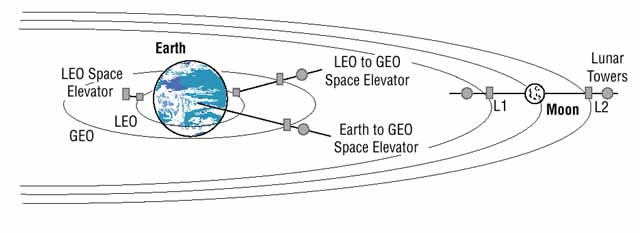 Source: NASATheir cable would be ninety-six thousand kilometers (fifty-nine thousand six hundred and fifty miles) long. A space solar power system would allow for unlimited solar energy to be transferred to a rectifying antenna that is the size of a golf course on Earth through microwaves. They have called their proposed project “Earth Port” with a floating base in the ocean with one connection to land and one to space. Their climber unit would travel to the International Space Station’s altitude in two and a half hours.
From proven marvels to near-future aspirations, these notable projects highlight civil engineering’s evolving expertise. As regulations and environmental demands shift, they keep pushing boundaries—delivering structures that power communities while making life a little easier for the rest of us.