Auto Sector Buys Every Second Industrial Robot
By Engineering360 News Desk | March 31, 2016Global industrial robot sales will grow 5% annually to 31,000 units by 2018, one-half of which will be installed by vehicle makers and their suppliers, according to the International Federation of Robotics (IFR).
Within the automotive sector, Japan currently boasts the highest "robot density," with 1,414 industrial robots for every 10,000 employees, followed by Germany, with 1,149, and the U.S., with 1,141 units, according IFR's 2015 World Robot Statistics. The North American automotive market nevertheless has and will continue to be a particularly strong driver of industrial robot growth, according to IFR.
"The automotive supply industry is providing a strong impetus to the deployment of robotic technology in North America," IFR says. "Investments within NAFTA [U.S., Canada and Mexico] have increased by about 40% every year since 2010 and are forecast to continue rising in [the] coming years."
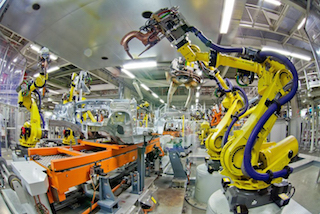 Within NAFTA, 55% of the total demand for industrial robots comes from the auto sector. Image credit: IFR. According to IFR, within NAFTA 55% of the total demand for industrial robots comes from the auto sector alone. The primary drivers of industrial robot investments among automotive suppliers are new quality standards, more energy-efficient production and new materials.
"Clearly the automotive industry continues to drive innovation in the automation arena [with its] need for optimization, quality, adaptability and flexibility," says Joe Gemma, IRF president. "The need from the OEMs has filtered down to the supplier base to work on improved quality, flexibility and process optimization."