Turning voltage into bits: How pH sensors have gone digital
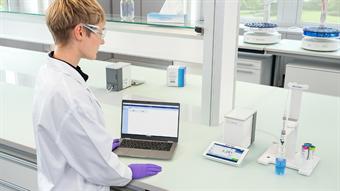
Kajal Jaiswal, courtesy of Mettler Toledo | June 25, 2025pH measurement is a fundamental parameter in various fields such as environmental monitoring, chemical processing, pharmaceuticals, food and beverage and water treatment. Selecting the right pH sensor — whether analog or digital — can significantly influence the accuracy, reliability and efficiency of measurements. Below is a detailed exploration of the differences between analog and digital pH sensors.
Understanding pH sensors
pH sensors typically consist of a glass electrode that produces a voltage proportional to the hydrogen ion activity (pH level) in a solution. This voltage signal then needs to be interpreted by an instrument or system.
 Source: Mettler Toledo
Analog pH sensors
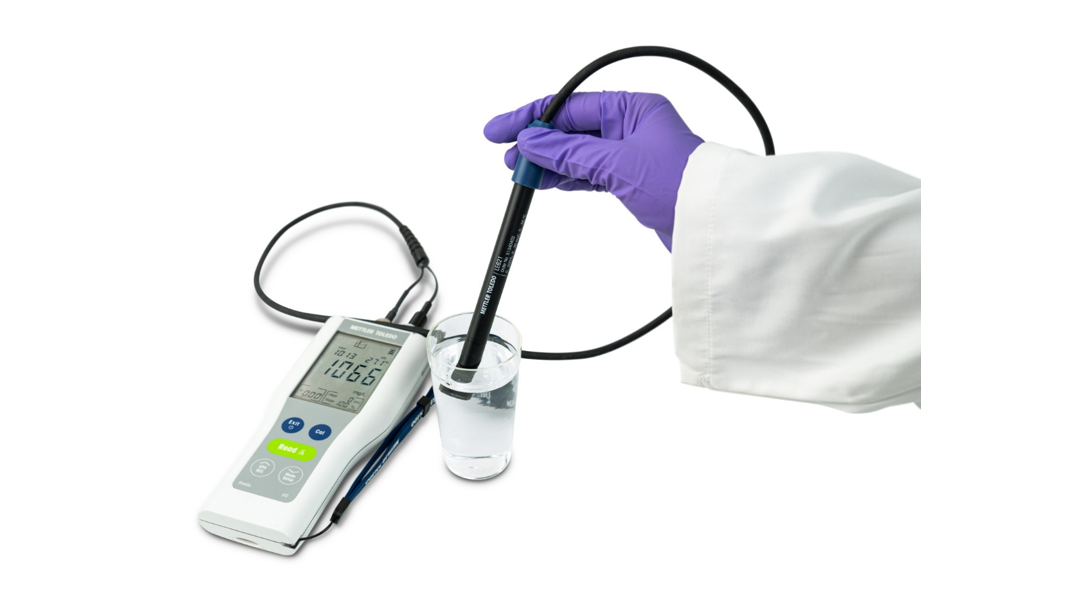
Analog sensors generate continuous signals or voltages that vary smoothly over time. The output is a continuous range of values representing the measured parameter. Mettler Toledo offers a range of analog sensors where an analog temperature sensor might output a voltage that changes proportionally with temperature changes. These sensors typically produce signals in the form of voltage or current that can be read by an analog-to-digital converter (ADC) to be processed by digital systems.
 Source: Mettler Toledo
How they work
Analog pH sensors output a small analog voltage signal, generally in the millivolt range, that corresponds linearly to the pH value. This voltage signal is continuous and varies smoothly as the pH changes.
Advantages
- Simplicity: They have fewer components and are straightforward in design.
- Cost-effective: Less expensive.
- Flexibility: Can be used with a wide range of signal conditioning equipment.
Challenges
- Signal conditioning required: The weak millivolt signal requires amplification and noise filtering.
- Noise sensitivity: Analog signals are prone to electromagnetic interference, which can introduce errors.
- Calibration and temperature compensation: These usually require external devices or manual processes.
- Data interpretation: Analog signals need to be converted to a digital format (via ADC) for most modern systems, adding complexity.
Digital pH sensors
Digital sensors, on the other hand, produce discrete signals usually in the form of binary data (0s and 1s). Instead of a continuous range, the output represents specific states or levels. Digital sensors often have built-in signal conditioning and an ADC to convert the measured parameter into a digital signal before sending it out. This makes them more compatible with microcontrollers and digital systems.
How They Work
Digital pH sensors integrate an internal amplifier, an ADC and often a microprocessor. They process the raw signal internally and output a ready-to-use digital signal.
Advantages
- Noise immunity: Digital signals are less susceptible to electromagnetic interference, enhancing measurement reliability.
- Integrated temperature compensation: Most have built-in temperature sensors to automatically adjust pH readings.
- Ease of integration: Digital output can be connected directly to microcontrollers, PLCs or computers.
- Higher accuracy and repeatability: Internal processing reduces errors.
Challenges
- Higher cost: More complex electronics increase the initial investment.
- Power requirements: Typically require a power supply for internal electronics.
- Repair complexity: Integrated electronics can be more difficult or costly to service.
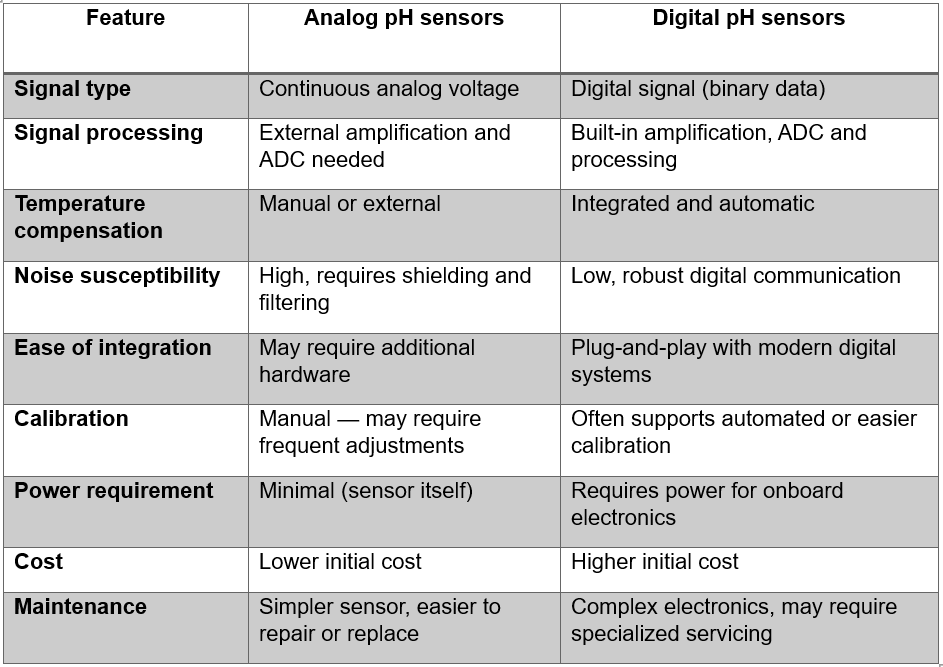
Feature comparison
 Source: Mettler Toledo
Practical considerations
- Environment: In electrically noisy environments (e.g., industrial plants), digital sensors generally provide more reliable data.
- Application complexity: For simple applications or legacy systems, analog sensors may suffice.
- Data needs: If integration with IoT devices, data logging or automated control systems is required, digital sensors provide easier implementation.
- Budget: Consider upfront costs versus long-term benefits like reduced maintenance and improved data quality.
In summary, both analog and digital pH sensors have their places depending on the application requirements. Analog sensors offer simplicity and lower initial cost but may need additional equipment and can be more prone to noise. Digital sensors, with integrated electronics, provide improved accuracy, ease of integration and noise immunity, but at a higher cost and power consumption. Evaluating the measurement environment, integration needs and budget will guide the optimal choice between analog and digital pH sensors.
Discover more information about sensors on the METTLER TOLEODO website.
To contact the author of this article, email pHmatters@mt.com.