From concept to compliance: Traceability in pH measurements
Neha Shinde, courtesy of Mettler Toledo | July 15, 2025 Source: Mettler Toledo; Lab pH Instruments
In various industries, accurate measurements of quantities such as mass, volume, temperature, light absorbance, pH, etc., are crucial for ensuring reliable results. However, the accuracy of these measurements hinges on a vital concept known as traceability, which ensures that results are consistent and can be traced back to a recognized standard.
Why is there a need for standards?
Consider the concept of a traffic light. When drivers approach an intersection, they universally recognize the meanings of red, yellow, and green lights: red means stop, yellow means caution and green means good to go. These signals are accepted by everyone on the road to ensure safety and order. Just like the traffic light system, a universally accepted standard in laboratories is recognized by all labs, guiding them to perform tests and measurements precisely while ensuring quality. In this context, traceability serves as a green signal for measurement reliability!
One important parameter, pH, which indicates how acidic or basic a solution is, can significantly affect chemical reactions, product quality, and compliance with regulatory standards. To ensure reliable pH measurements, laboratories often use standardized buffer solutions. These buffers, which have known pH values, serve as reference points for calibrating pH meters and sensors. By establishing a traceable measurement system using these buffer standards, laboratories can maintain confidence in their results, ultimately supporting better decision-making and quality control in their processes.
What is traceability?
According to VIM (Vocabulary of International Metrology), the term “traceability” is sometimes used for ‘metrological traceability’ as well as for other concepts, such as ‘sample traceability', ‘document traceability’ or ‘instrument traceability’, where the meaning is completely different. Therefore, the full term is preferred. In this article, the term "traceability" will specifically refer to the metrological traceability of pH measurements.
According to ‘IUPAC Recommendations 2002, Pure Appl. Chem., Vol. 74’, traceability is the “property of the result of a measurement or the value of a standard whereby it can be related to stated references, usually national or international standards, through an unbroken chain of comparisons all having stated uncertainties. The concept is often expressed by the adjective traceable. The unbroken chain of comparisons is called a traceability chain.”
In simple words, traceability of pH measurements is the ability to verify the accuracy by linking them to recognized national or international standards. To trust the results of measurements done by different people using different equipment, we need to ensure that the results can be compared fairly, even if the tests were performed at different times and places. This is called comparability. For results to be comparable, we must understand how much uncertainty there is in the measurements. This uncertainty means acknowledging that there might be some error in the results.
To ensure the reliability of measurement results, regulatory agencies and international quality standards - ISO/IEC 17025:2017 (Chapter 6.5) require that the laboratory establish and maintain metrological traceability of its measurement results using a documented unbroken chain of calibrations. This chain links each measurement to an appropriate reference standard, typically the International System of Units (SI), which is universally recognized.
Unbroken chain of comparisons
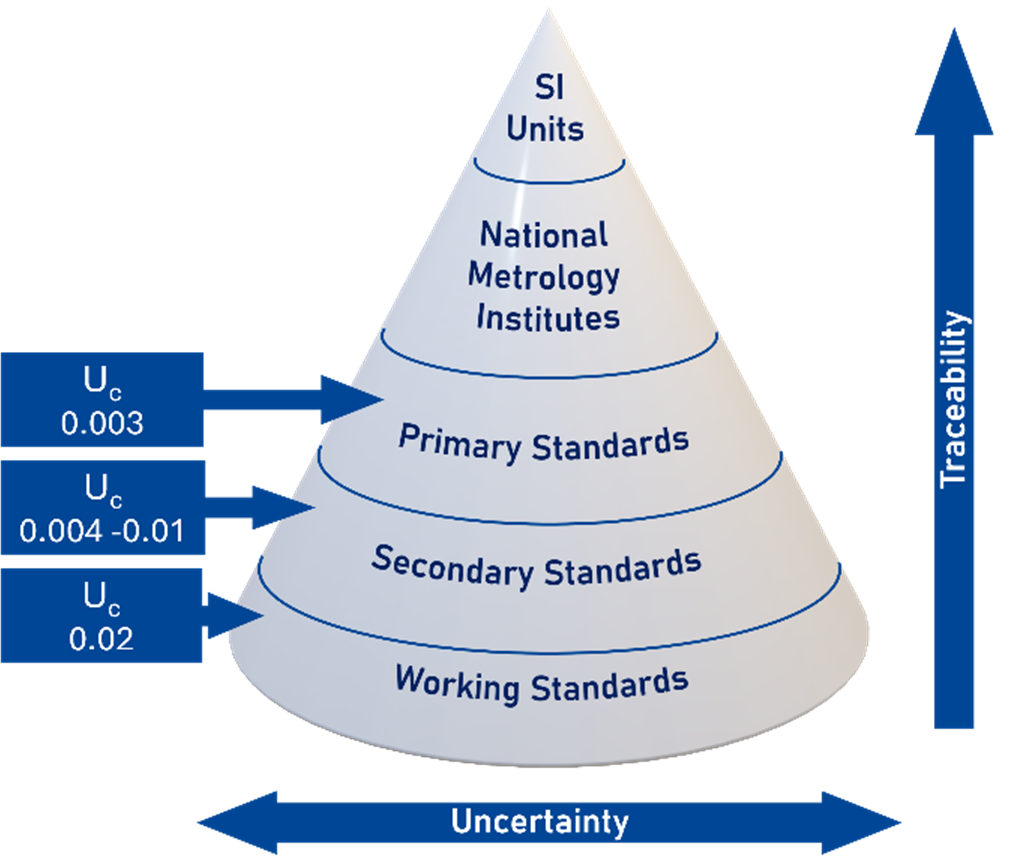 pH traceability pyramid. Source: Metter Toledo; Lab pH InstrumentsThe metrological traceability chain is 'the sequence of measurement standards and calibrations that are used to relate a measurement result to a reference'. It refers to the requirement that each step in the calibration process must be directly or indirectly connected to a recognized standard, ensuring that the measurement uncertainty (Uc) is accounted for at each stage of the chain. The stages are arranged based on their measurement performance, which is often illustrated by the Traceability Pyramid (Fig. 2).
The traceability pyramid is defined through a calibration hierarchy. Starting with the highest accuracy at the top and moving down to the lowest. The top one provides high traceability with minimal uncertainty. As we move down the pyramid, the pH buffer standards are still useful, but they are less traceable and have a higher degree of uncertainty in their measurements.
Think of it like a game of telephone: the message to begin is clear and precise, but as it gets passed down the line (or the pyramid), each person adds their interpretation, which can introduce confusion or errors. To keep the quality of measurements high at every level, each step in this chain of traceability must be carefully managed and controlled, ensuring that the result remains as accurate as possible. A single mistake, such as inadequate documentation, i.e., poor record-keeping of calibration dates, standard solutions used, and measurement conditions, can lead to a break in the traceability chain. When this happens, we can no longer confidently trace measurements back to their original standards, leading to inaccuracies and undermining the reliability of pH measurement results.
Steps to establish and maintain pH traceability
Consider the following practices to build trust in traceability measurements
Selection of reference standards
The pyramid structure in Fig. 2 highlights the critical role of primary standards, which are established by National Metrology Institutes (NMIs), in maintaining a reliable pH traceability chain. These standards are used as a reference for global comparison.
Role of NMIs
NMIs develop and maintain the primary measurement standards that serve as the reference for all measurements in their respective countries. The quantitative value of the primary standards is realized by the primary measurement procedure set by NMIs. The assignment of value and uncertainty at NMIs for primary pH buffer solutions is based on IUPAC recommendations. The currently recommended primary buffer solutions utilize a multipoint pH protocol developed by Bates and colleagues at the National Bureau of Standards (now NIST - National Institute of Standards and Technology). The multipoint protocol involves calibration at different stages from the Harned cell for primary standards to the working standard by pH glass electrode.
The accuracy of these national measurement methods for pH compared to international standards (SI) is checked through international comparisons. These comparisons are organized by the Electrochemical Analysis Working Group (EAWG), which is part of the Consultative Committee on Metrology in Chemistry (CCQM) under the International Bureau of Weights and Measures (BIPM).
Once the pH traceability chain is established, the pH buffers are certified with the following information:
Certificate of Analysis (CoA)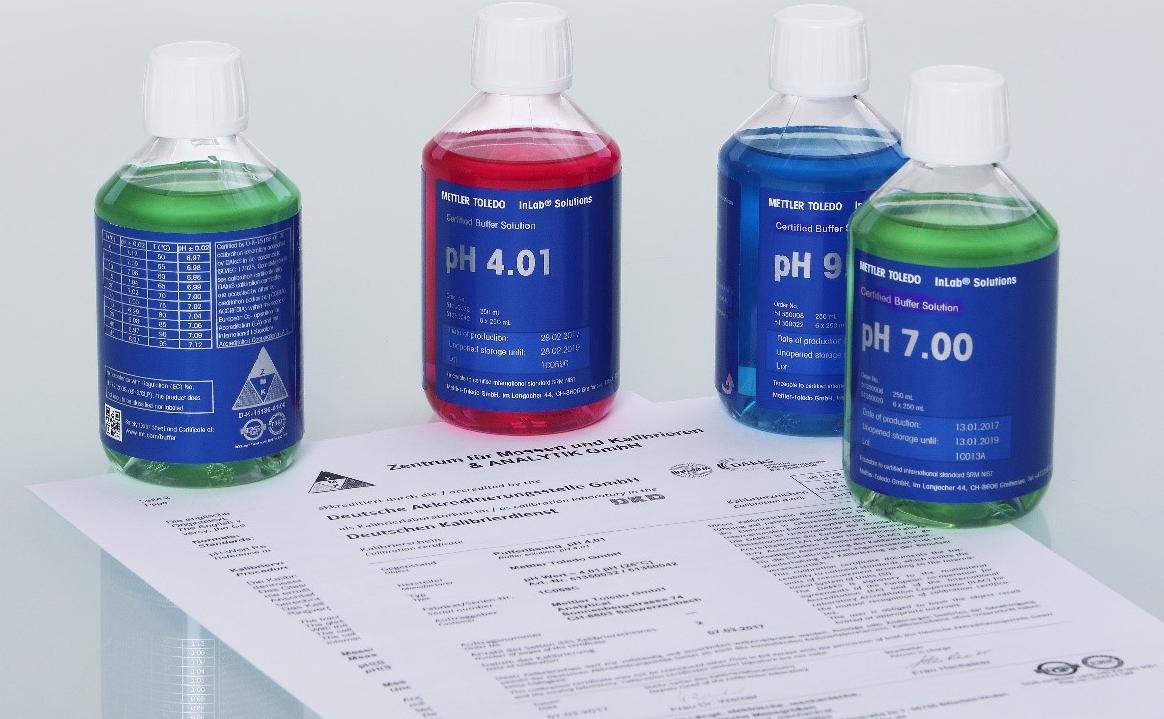 CoA with pH buffers. Source: Mettler Toledo; Lab pH Instruments
1. The quantitative traceability value and calculated uncertainty
2. Calibration methods used (Standard procedures)
3. Certified Reference Materials (CRMs) used during calibration
4. The lot number of every CRM used during the quality control process
5. Environmental Conditions (Temperature, humidity, etc.)
6. Instrument used
7. Date and time data
8. Final statement - Traceable to International Standards (SI units)
Consider these common options for selecting a reference standard for pH measurement.
- Accredited laboratory certification: Follow the rigorous steps to have primary standards certified by an accredited laboratory. However, this process can be quite expensive and time-consuming, requiring significant resources to ensure compliance.
- Market-available certified pH buffers: Alternatively, choose certified buffers that are already available in the market, like Mettler Toledo’s pH buffer solutions. These products come with guaranteed traceability to SI units. Trusting these ready-to-use solutions can simplify the calibration process without compromising on accuracy.
Ensuring traceability in pH buffer purchases
To maintain the highest standards of quality and compliance, while purchasing pH buffers, always verify all eight details listed above under the Certificate of Analysis (CoA). This not only ensures traceability but also enhances the reliability of measurements.
Once the establishment phase is complete, ongoing maintenance, regular checks, and care are crucial, which include adhering to standardized procedures for measuring pH and following proper calibration and maintenance protocols. The steps for maintenance are as follows.
1. Calibrate instruments regularly
Ensure that pH meters and sensors are calibrated regularly against recognized standards to maintain accuracy. Follow proper measurement practices throughout the experiments to maintain traceability.
2. Document all measurements
Keeping detailed records of all pH measurements is vital for traceability. This documentation should include information such as the date and time of measurement, environmental conditions (e.g., temperature and humidity), specific calibration data, and any deviations from standard procedures observed during the process. Such records not only help trace the lineage of data but also facilitate troubleshooting and ensure accountability in measurement practices.
3. Train personnel
Staff should be educated about the significance of traceability, the procedures to follow, and the proper use of equipment. Training sessions should also cover the consequences of improper measurements and the importance of maintaining compliance with regulatory and organizational standards. Ongoing training and refreshers help reinforce these concepts and ensure that all personnel are equipped with the latest information and techniques.
4. Conduct internal audits
Regularly review and audit pH measurement processes to ensure compliance with traceability requirements. These audits should evaluate both the processes, and the documentation associated with pH measurements, i.e., Method validation and verification. They help identify areas for improvement, ensure compliance with traceability requirements, and foster a culture of continuous improvement within the organization. Any findings from audits should be addressed promptly to enhance future performance.
To simplify these challenging steps, advanced technology can significantly enhance the traceability of pH measurements. For instance, Mettler Toledo's pH meters and sensors come equipped with automatic traceability maintenance options that streamline the calibration and documentation process. These meters utilize digital technology to maintain records of previous measurements automatically, ensuring that all data is accurately captured and easily accessible. Furthermore, the meters provide guided instructions to help users perform experiments flawlessly. Additionally, software solutions such as pH LabX can assist in method validation, compliance tracking, and other essential documentation requirements, ensuring that organizations not only meet but exceed traceability standards in their pH measurement processes.
Reminder: Traceability refers to the "result of measurement" itself, not the instruments, standards, or calibration methods used. It's only about ensuring that measurement outcomes can be linked to recognized standards, emphasizing the reliability and applicability of those results.
From the beginning of this article, the importance of traceability in compliance with regulatory standards is highlighted. Now that we understand how crucial traceability is and the underlying concepts, let’s conclude with the reasons why we need traceability in pH measurements.
Significance of traceability for compliance
Traceability in pH measurements is important for ensuring accurate and reliable results, which are foundational to compliance with international standards such as ISO 17025 and ISO 9001. It helps in quality assurance and supports research and development with risk management. For manufacturers, traceability ensures that products meet consistent specifications, preventing compatibility issues in use. Furthermore, it instills confidence in the validity of measurement results, highlighted by calibration certificates that include numerical values of traceability and associated uncertainties. This precision is critical, especially in industries like pharmaceuticals, food and beverage, and chemical manufacturing, where non-compliance can lead to product rejection, economic losses, and waste generation. Many industries are subject to stringent regulations that mandate specific quality standards. For instance, the pharmaceutical industry must adhere to regulations set by organizations such as the FDA (U.S. Food and Drug Administration) and EMA (European Medicines Agency). These regulations often require that all measurements, including pH, be traceable to national or international standards; otherwise, the whole batch of product will be rejected. Ultimately, robust traceability systems in pH measurements are essential for product safety, quality assurance, and environmental sustainability.
References
- ISO/IEC 17025:2017 White Paper | METTLER TOLEDO
- pH Measurements Following USP 791
- R. P. Buck, S. Rondinini, F.G.K. Baucke, C.M.A. Brett, M.F. Camões, A.K. Covington, M.J.T. Milton, T. Mussini, R. Naumann, K.W. Pratt, P. Spitzer, G.S. Wilson, Measurement of pH. Definition, Standards, and Procedures; IUPAC Recommendation 2002, Pure Appl. Chem, 2002, 74, 2169-2200.
- Spitzer, Petra & Seitz, Steffen. (2010). Metrological Traceability Chain for pH Measurement Results. Mapan - Journal of Metrology Society of India. 25. 191-196. 10.1007/s12647-010-0019-5.
- International vocabulary of metrology – Basic and general concepts and associated terms (VIM) 3rd Edition
To contact the author of this article, email pHmatters@mt.com