Sound technology helps locate seafloor munitions
Marie Donlon | June 17, 2025Researchers at the University of Texas at Austin are examining the changes in the acoustic characteristics of unexploded ordnance (UXO) — weapons that did not explode following deployment — after they have been discarded at underwater sites and then subjected to corrosion and biofouling.
"Many of these sites are in shallow water, potentially posing a threat to human safety, and date back several decades," explained the researchers. "This long exposure to the environment leads to corrosion as well as encrustation in the form of barnacles or algal growth."
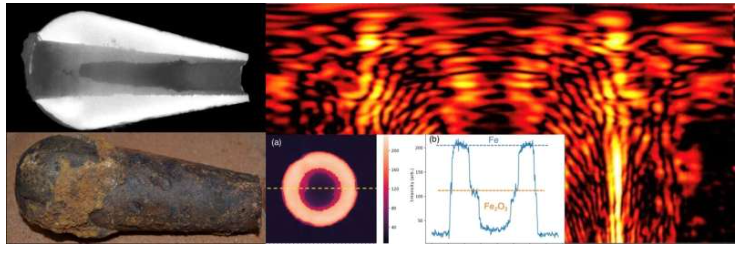 Clockwise from bottom left: photo of corroded bomblet, X-ray CT scan of the same bomblet, acoustic fingerprint of the bomblet with corrosion signature cross section of the bomblet (inset). Source: Kevin Lee, Connor Hodges, and Preston Wilson
The researchers explained that corrosion and growth make UXOs hard to detect with standard sonar imaging techniques alone. Because the objects begin to lose resemblance to their original form and instead blend into their environment over time, these changes can alter how acoustic signals scatter from the objects, and those changes can become more intense over time as corrosion or organic growth increase.
The researchers tested an assortment of AN-Mk 23 practice bombs — which are miniature bombs used for dive-bombing practice — at different stages of corrosion. The team measured the acoustics of these samples against those of un-corroded AN-Mk 23 and monitored the scattering response at the different directions and angles.
The team discovered that changes in size, shape and material composition of a bomb as it corrodes alters its acoustic resonance and produces a different, weaker scattered acoustic signal than the un-corroded bombs. This altered acoustic signature might result in the UXO being misclassified or undetected.
"Acoustic scattering techniques give an insight into the internal structure of the object imaged, as well as a method to 'see' into the seafloor," the team added.
The team envisions that their findings will lead to better predictive tools for finding UXOs in civilian environmental demining efforts and they plan to also study other types of munitions along with other types of corrosion and biofouling.