Liquid waste, solid future: Urine turns into sustainable concrete
Marie Donlon | May 22, 2025A team of researchers at the University of Stuttgart are using microbial processes to manufacture environmentally friendly bio-concrete derived from urine.
Because the manufacture of conventional cement involves firing the material at extremely high temperatures, thereby consuming a lot of energy and subsequently releasing large quantities of greenhouse gases, the researchers sought to develop a so-called bio-concrete.
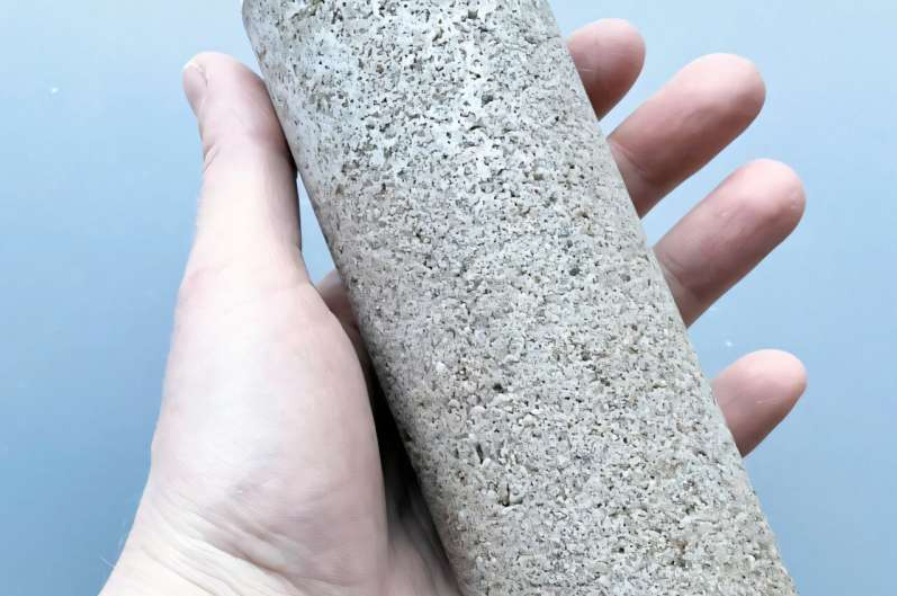 Source: University of Stuttgart / ILEK / IMB / ISWA
The team explained that due to its high compressive strength, this bio-concrete, which is derived from human urine, not only replaces traditional sandstone and, sometimes, cement-based concrete, it can also potentially be produced entirely from waste materials and thus has a significantly lower environmental footprint.
According to its developers, the bio-concrete is produced through biomineralization, which is a biotechnological process wherein living organisms create inorganic material via chemical reactions.
The researchers mixed a powder containing bacteria with sand, placed the mixture into a mold and then flushed it with calcium-enriched urine over a period of three days using an automated process. Through the process of breaking down urea with the bacteria and the addition of calcium to the urine, crystals of calcium carbonate were encouraged to grow, thus solidifying the sand mixture into bio-concrete. The final product of this process is a solid that is chemically similar to natural calcareous sandstone, the researchers noted.
Based on the molds used, the bio-concrete can be transformed into various shapes and sizes, with a current maximum depth of 15 cm.
In the lab, technical urea achieved a compressive strength of over 50 megapascals — far surpassing the strength of other building materials created through biomineralization.
The team noted that when using urea in artificial urine, a compressive strength of roughly 20 megapascals was achieved while real human urine achieved 5 megapascals. This is because bacteria lose their activity over the course of the three-day biomineralization period.
To improve this result, the team determined that a strength of 30 to 40 megapascals in the biomineralized material would be sufficient for constructing two- to three-story buildings.
Further, the team is also conducting out freeze-thaw tests to determine if the material can be used outdoors.
"The production process for our bio-concrete consumes considerably less energy and causes fewer emissions than conventional cement production. But our approach is also sustainable because we embed the product in a circular value chain," the researchers explained.
To source the human urine for the manufacture of bio-concrete, the team has also drafted a concept that shows how urine could potentially be separated and processed from the partial wastewater flow in locations with a high volume of people, such as an airport.
An article detailing the team’s findings, High strength bio-concrete for the production of building components,” appears in the journal npj Materials Sustainability.