SunRod micro-cartridge heaters: Long life and dependable performance
May 01, 2025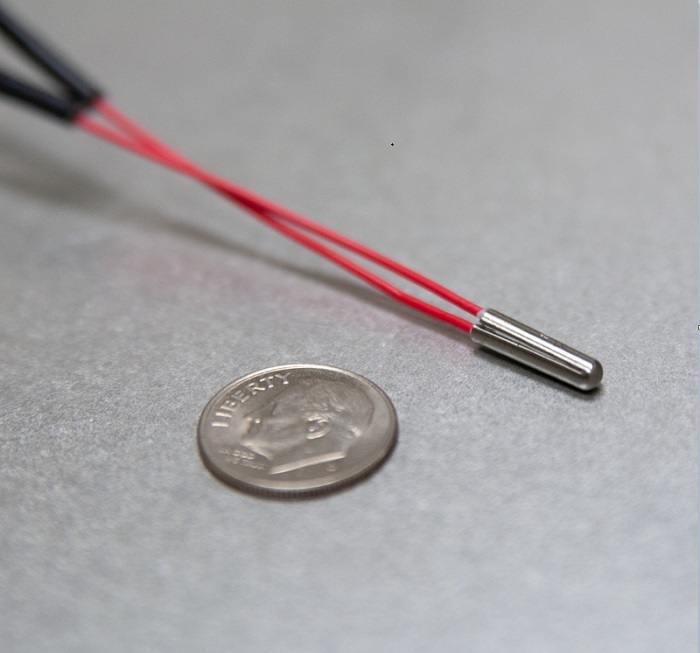 Figure 1: SunRod miniature heating cartridges are used by companies in a wide range of industries. Source: Backer Hotwatt
Introduction
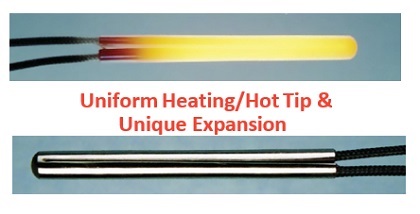 Figure 2: Uniform heating/hot tip and unique expansion. Source: Backer Hotwatt
- Medical
- Aerospace
- Food
- Defense
- Energy
- HVAC
- Manufacturing
- Easy installation
- Faster response
- Uniform heating
- Longer operating life
What are micro-cartridge heaters?
What is a micro-cartridge heater, and what is it used for?
A micro-cartridge heater is a miniature tube-shaped heating element designed for insertion into a small-diameter borehole. The cartridge consists of an outer metal shell, called a sheath, which contains a coil of heating wire surrounded by insulating material. When powered up, the coil begins to heat up, which in turn, heats up the sheath, which then heats up the surrounding metal.
Cartridge heaters provide localized heat to restricted work areas requiring precise thermal control. To function efficiently, a micro-cartridge heater must be able to maintain a stable, uniform temperature. Closely controlled work temperatures of up to 1,200° F (648.9° C) can be obtained by a combination of heater location and proper wattage output.
Micro-cartridge heaters are used to heat the metal surfaces of dies, platens and other types of processing equipment. They play an important part in a wide range of engineering and manufacturing applications, including:
- 3D printing
- Medical devices
- Injection molding
- Semiconductors
- Mass spectrometry
- Laminating presses
- Die casting
- Food production
- HVAC compressors
- Fluid and gas heating
- Sensor measurement devices
Why uniform heating is so important
For example, in the food industry, a consistent temperature must be maintained to ensure that a food product is cooked thoroughly and evenly, not just for the desired taste, but also to avoid spoilage and contamination.
Even heat distribution within the micro heater means more uniform temperatures for a process. To achieve the necessary temperature stability and consistency, the micro-cartridge heater must be able to generate heat continuously along the entire length of the heater.
Also, temperature inconsistencies can shorten heater life as effectively as overall overheating. Therefore, it is important to ensure consistent temperatures over the entire length of the heater body.
Factors that affect the operating life of a micro-cartridge heater
The industry-standard warranty for electric cartridge heaters is 2,000 hours, or one year on a single shift. This is a reasonable life expectancy for many applications. However, some applications require an operating life expectancy much longer than that. Before discussing
how to achieve longer operating life, let’s take a look at some of the factors that affect micro heater performance and life span.
How element resistance affects heater life
For this discussion, the guide explores the causes and effects of resistance changes during the operation of 1/8-inch micro-cartridge heaters, including their effects on heater performance and heater life.
For a point of reference, the type of heater being discussed is a metal-sheathed cartridge heater, electrically insulated with compacted magnesium oxide, with a helical resistor embedded within. The resistor is an 80% nickel and 20% chromium alloy, such as Kanthal-80 or Chromel-A.
There are four causes of variable resistance:
- Variations in the as-manufactured resistance of the heater
- Permanent increase on first heat-up
- Transient increase with each heat-up
- Gradual permanent increase due to “aging”
Except for variations due to manufacturing tolerances, all the above effects are directly related to the operating temperature of the heater’s internal resistor element. It is important to keep in mind that the temperature of the internal resistor element can be as much as 200° C higher than the system temperature.
Cause #1: Variations in as-manufactured resistance
The resistance of an electric heater is typically subject to manufacturing tolerance. Miniature cartridge heaters have a standard tolerance of minus 10% to plus 15%.
Tighter tolerances are available, depending on heater length. With special processing, 1/8-inch cartridge heaters may have a minimum tolerance of +/- 7%.
Where heaters are used in pairs, it is often possible to sort them by resistance to create matched pairs whose resistance varies only by 1% or 2%.
Cause #2: Permanent resistance increase on first heat-up
The initial heat-up of the heater (as received from the factory) results in a permanent increase in resistance, typically between 2% and 6%. This is due to oxidation of the resistor and the relieving of stresses created during the fabrication of the heater. As a result, a 100-ohm heater (as manufactured and measured at room temperature) may return to room temperature as a 104-ohm heater. The exact increase is dependent on the temperature reached.
Subject to manufacturing variations from system to system, this increase is repeatable and can usually be determined by customer testing.
Cause #3: Transient resistance increase
With every heat-up, the resistance of the heater will increase as much as 6%. This increase is linear in the range between 0° F and 500° F and is superimposed on the permanent increase described in the section above. As a result, a 104-ohm heater at room temperature may have a resistance of 107 ohms at operating temperature.
The amount of change depends on the end operating temperature of the heating element within the heater. Subject to manufacturing variations from system to system, it is repeatable and may be determined by customer testing.
Cause #4: Aging
Aging is a process of oxidation of the resistor alloy within the heater. Oxidation causes the heater’s resistance to progressively increase. During service at extreme temperatures, the heating capacity may be reduced until it reaches a point where the demands of the process can no longer be met.
Aging may occur locally as well, raising the resistance of the internal element in isolated segments of the heater, resulting in uneven heating in the system, or “hot spots.” Local overheating can shorten heater life as effectively as overall overheating. Therefore, it is important to ensure consistent temperatures over the entire length of the heater body.
Thermal cycles, such as heating up and cooling down, and steady-state operation for process loading or heat control to maintain set point temps, can impact the expansion rates of the nickel-chromium alloy and its protective chrome oxide, as they are not identical. With each heating/cooling cycle, cracks may open in the oxide layer, exposing the underlying metal to further cycles of oxidation.
Extending heater life
As stated earlier, the industry-standard life span for electric cartridge heaters is one year, or 2,000 hours. However, some applications require cartridge heaters with an operating life expectancy of five, seven or even 10 years. These include the blood warmers used in medical procedures; the battery conditioners for EVA spacesuits on the International Space Station, which must last 10 years before replacement, due to payload costs; and semiconductor chip testers that must operate without significant downtime.
How are longer operating life spans achieved?
The simple answer is that designing cartridge heaters with reduced watt density multiplies service life.
For every heater power loading (See “Calculating watt density” below*), there is a maximum operating temperature that will guarantee 2,000 hours of life. This is the “critical temperature” for that power loading. The system temperature versus maximum watt density chart below illustrates these numbers.

Go above the critical temperature by 100° and life will be cut to a third, to 666 hours. But go below it by 100° and heater life will be tripled, to 6,000 hours! This relationship can be used to determine the watt density at a given system temperature that will yield thousands of hours of extra life.
For example, let’s suppose that a system requires a processing temperature of 500° F with an input power of 80 watts. A 1/8-inch by 1-inch cartridge heater could provide the necessary wattage and would have a power density of 270 watts per square inch. As can be seen from the power chart, a heater with a power loading up to 275 watts per square inch would be acceptable. Heater life would be a respectable 2,000 hours.

But what happens if a 1-1/4-inch heater is used, just a 1/4-inch longer? The heater’s power loading is lowered to 210 watts per square inch. The critical temperature is raised by 200°. The heater is now operating 200° below the new critical temperature, and heater life is increased to 18,000 hours (2,000 hours x 32)!

How to reduce watt density?
Heater watt density may not have to be reduced. Many miniature heating applications inherently require relatively little wattage, due to their small mass. This often results in minimal power loading on a 1/8-inch miniature heater. In these cases, miniature cartridge heaters
are often under-loaded by 200° to 400°, relative to the critical temperature. Their 2,000-hour life expectancy may be multiplied up to 81 times!
Increasing surface area to reduce watt density
Surface area can be increased to reduce watt density in the following ways:
• Maximize heater length. Increasing the length of a 1-inch heater to 1-1/4-inch (just 1/4-inch) can increase the active area by 33%, reducing power loading by 25%.
• Consider using more heaters. Two heaters dividing the load will reduce watt density by 50%.
• Take advantage of any available space to install a supplemental heater. Adding a 1/2-inch- long heater to an existing 1-inch heater can reduce power loading by 25%.
Calculating watt density
Watt density is the power loading of the heater, expressed in watts per square inch of active heater surface.
• The formula for active heater surface is: (Heater length – cold end length) x diameter x Pi. For a 1/8-inch diameter by 1-inch-long heater it is: (1.00 - 0.25) x .38, or .285 square inches.
• The formula for watt density is: Wattage/active heater surface. For a 1/8-inch diameter by 1-inch heater at 80 watts, this is 80 watts/.285 square inches or 270 watts/square inches.
Micro heater installation and removal
Proper installation and removal play a big factor in the reliable performance and life span of a cartridge heater.
It starts with choosing the right heater for the application. First, consider the size. A heater cartridge should always fit snugly in the borehole. Air gaps between the cartridge and the borehole can reduce the efficiency of heat transfer and considerably shorten the lifespan of the heater.
To address this problem, SunRod micro heaters incorporate a unique sheath design that expands when heated to rest in the borehole more snugly.
The heater should be durable enough to avoid damage during the installation and removal process.
The condition of the borehole plays a part as well. To ensure the best heat transfer, it should be reamed to the exact size. The inside of the hole should be smooth, uniform and of an even diameter. It should have an outlet to provide for easy removal of the heater cartridge. Depth is important, too — the heater connectors should never extend into the hole to prevent the risk of shorting out and burning. The connectors should be protected against accidental liquid spills or gas leaks as well.
To make things easier, look for micro heating cartridges that can be installed and serviced on site. No complicated bonding or clamping should be required, and the mounting method should not inhibit heat flow from the device under test (DUT) to the heat sink during the cooling phase.
How the SunRod design improves performance and operating life
There are many brands of micro-cartridge heaters on the market, but few provide the performance and reliability of SunRod’s line of burn-in test socket heater cartridges. Computer-designed and built in the U.S., SunRod cartridge socket heaters are specifically manufactured to meet the exacting standards required for today’s burn-in test socket applications.
Split sheathing, longer life, uniform heating and easy installation in the smallest devices are just a few of the reasons why more companies are choosing SunRod burn-in test socket heaters for their engineering and manufacturing applications.
Ideal for a wide range of applications
Backer Hotwatt’s burn-in test socket heaters are ideal for a wide range of applications, including semiconductors, medical devices, 3D printing, die casting, mass spectrometry and injection molding, to name just a few.
Split-sheath design improves efficiency
Backer Hotwatt’s socket heaters utilize an exclusive split-sheath design that eliminates the failure points
of conventional miniature heaters. When energized, the split sheath expands into contact with the surrounding borehole. This allows for a rapid heat-up of the heat sink and DUT, resulting in maximum heat transfer, longer heater life (25,000 hours or more) and lower operating temperatures for the heater.
Easy slide-out removal
When de-energized, the split sheath contracts for easy, slide-out removal; it’s guaranteed never to seize in the bore.
Uniform heating
Unlike other cartridge heaters, Backer Hotwatt’s heaters generate heat continuously for the full length of the heater, including the tip, providing for uniform heating without any cold spots.
Smaller lengths
Backer Hotwatt’s unique manufacturing process allows for micro heaters of less than an inch in length.
SunRod socket heaters offer these additional benefits:
• Mounting method does not inhibit heat flow from the DUT to the heat sink during the cooling phase
• Installation and servicing occur at the factory or at the test site; easily installed in a small (3.2 mm/.125 inch) bore in the socket heat sink
• No complicated bonding or clamping is required
• Not susceptible to damage during installation
• Field serviceable; no returns to the manufacturer for heater removal or replacement
• High flexibility lead wires permit free motion of floating spring-loaded heater assemblies; small diameter (.8 mm/.032 inch) simplifies wire management within the test socket
• Higher wattages
• Longer life
Specifications and ordering
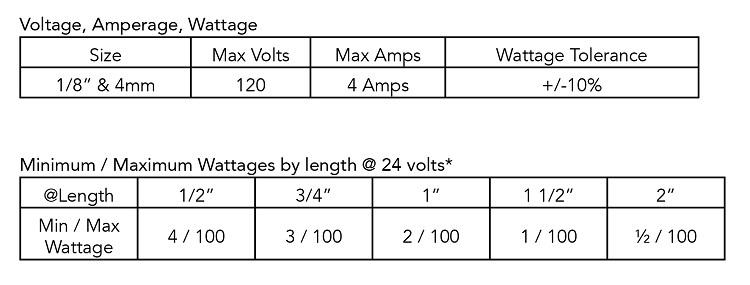
Electrical specifications
Mechanical specifications

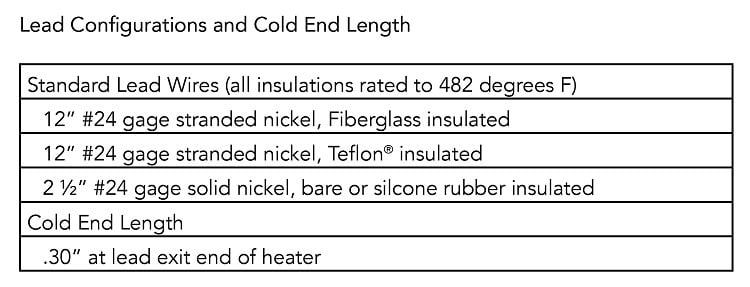
Standard features
- Quantity
- Sheath diameter
- Sheath length
- Wattage
- Voltage
- Lead length
- Lead insulation
Design guide for heating metal parts
Using the SunRod Power Chart

Use the SunRod Power Chart at right to determine the temperature/fit/watt density
parameters for an application.
1. Establish the desired temperature of the part to be heated.
2. Establish the fit of the heater in the part to be heated
by subtracting the minimum heater diameter from
the maximum possible bore diameter.
3. Enter the chart with two known parameters (typically, desired part temperature and fit), to determine the third parameter (maximum watt density).
1. Calculate the actual watt density of the heater, based on heater size and actual wattage requirements of the application. (See formula for calculating watt density, below.)
2. Read maximum allowable watt density at the intersection of the application’s temperature and fit. For example, the maximum watt density of a SunRod operating at a part temperature of 300° F with a fit of .004 inches is 525 watts per square inch.
3. If the heater’s calculated watt density exceeds the maximum allowable from the chart, consider using more, longer or larger SunRods to reduce it.

Summary
Split sheathing, longer life, uniform heating and easy installation in the smallest devices are just a few of the reasons why an increasing number of companies are choosing Backer Hotwatt SunRod burn-in test socket heaters over the competition.
Backer Hotwatt, Inc. acquired Sun Electric Heater Company, the manufacturers of the SunRod micro-cartridge heater. Through this acquisition, Backer Hotwatt has broadened its heating element product line to deliver more value to its customers. Whatever the design or engineering challenge is, Backer Hotwatt has the expertise and broad technology base to develop a customized and dependable product for unique needs. Whether users are heating air, fluids, gases or other surfaces, Backer Hotwatt engineers can develop a solution that helps an application function most efficiently.
Established in 1952, Backer Hotwatt, Inc. has been a trusted source of heating elements for OEMs in the industrial, semiconductor, medical, commercial, packaging, instrumentation, aviation, transportation, refrigeration/air conditioning and military fields for over 65 years. Contact them to learn how their line of burn-in test socket heaters and other heating products can deliver the solutions users are looking for.
Backer Hotwatt SunRod micro-cartridge heaters are manufactured in the U.S.; every unit is subjected to stringent in-process testing and multi-point quality assurance tests before delivery.
For more information about micro-cartridge heaters, visit Backer Hotwatt’s comprehensive micro-cartridge heaters resource page with detailed information about their diverse product line — the largest in the industry — helping solve difficult engineering and performance challenges. Contact them at (978) 777-0070 or at sales@hotwatt.com.