Uranium powers this rechargeable battery
S. Himmelstein | May 01, 2025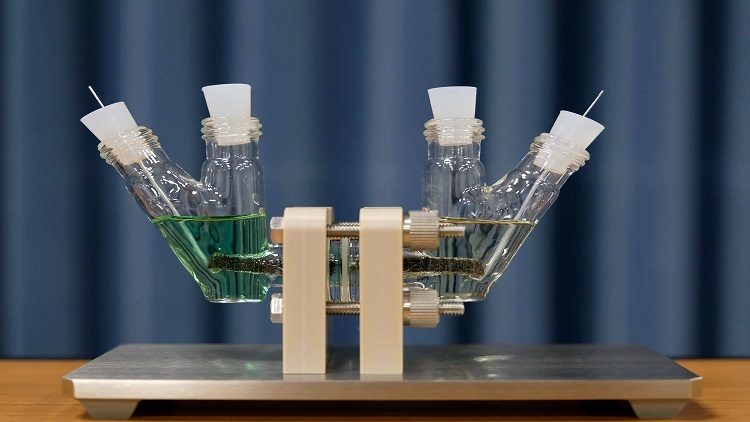 Source: Japan Atomic Energy Agency
A beneficial use for the depleted uranium generated as a byproduct of nuclear fuel enrichment and other processes has been demonstrated by Japan Atomic Energy Agency researchers. The problematic waste material forms the basis of a uranium rechargeable battery, the performance of which has been verified during charging and discharging.
The prototype battery, measuring 10 cm wide and 5 cm tall, employs a uranium-containing electrolyte for the negative electrode and an iron-containing electrolyte for the positive electrode. The single-cell voltage of the device is 1.3 V, which approaches that of a common 1.5 V alkaline battery.
After being charged and discharged 10 times, its performance was virtually unchanged, indicating relatively stable cycling characteristics.
The battery offers a promising solution for storing surplus electricity generated from renewable energy sources, addressing the inherent instability of solar and wind power. With a global depleted uranium stockpile estimated at 1.6 million tons, the technology could offer a viable pathway for utilizing this vast reserve of material.
The researchers will next focus on developing flow cells including electrodes for a higher-capacity battery. The larger design would use 650 tons of uranium and have a capacity of 30,000 kWh, roughly equivalent to the daily electricity supplied to 3,000 households in Japan.