
Advanced nuclear reactor now operational in China
S. Himmelstein | February 18, 2021China has become the fourth country to master its indigenous Generation III nuclear power technology following the U.S., France and Russia. Hualong One, or HPR 1000, Generation III technology has been put into commercial operation at Unit 5 of China’s Fuqing Nuclear Power Plant. Improvements realized in this reactor are intended to result in a longer operational life compared with currently used Generation II units.
The system developed by the China National Nuclear Corporation represents an evolutionary design based on proven technology of the existing pressurized water reactor and incorporates advanced design features 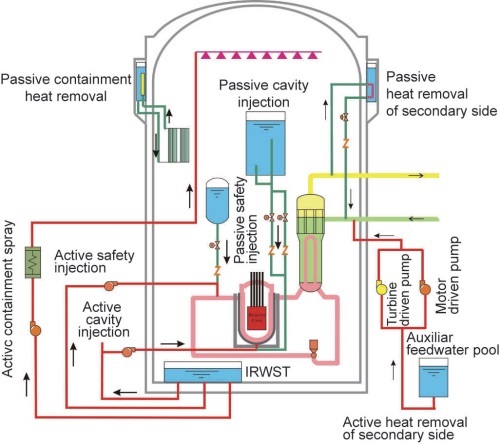 Active and passive cooling systems of the HPR1000. The red line denotes active systems and the green line represents passive systems. Source: Ji Xing et al.including a 177-fuel-assembly core loaded with China Fuel 3 fuel assemblies containing pellets of either uranium dioxide or a mixture of gadolinium oxide and uranium dioxide. HPR 1000 is also engineered with active and passive safety systems, comprehensive severe accident prevention and mitigation measures, enhanced protection against external events and improved emergency response capability. Extensive verification experiments and tests have been performed for critical innovative improvements on passive systems, the reactor core and the main equipment.
The design of HPR1000 fulfills international utility requirements for advanced light water reactors and the latest nuclear safety requirements and addresses the safety issues relevant to the March 2011 Fukushima Daiichi Nuclear Power Plant accident in Japan.
The installed capacity of each Hualong One unit reaches nearly 1200 MWe and each can generate nearly 10 billion kWh of electricity annually. The electricity generated by one HPR 1000 is equivalent to eliminating 3.12 million tons of standard coal consumption and emission of 8.16 million tons of carbon dioxide emissions annually. The new reactor also offers a design life of 60 years.



That would seem to be one way to shed Coal-Dependency, and give the atmospheric pollution a chance to settle-out, a little bit more, each year, for the next 60 years ...