Bifacial Solar Modules Ready for U.S. Tests
Engineering360 News Desk | March 11, 2016The Oregon-based manufacturing hub of SolarWorld, based in Germany, has produced its first bifacial Bisun modules for installation as part of a 205-kW system at the University of Richmond, in Virginia. These modules capture both direct solar radiation on the front side as well as indirect sunlight on the back, producing up to 25 percent more energy than standard solar panels of the same nominal wattages.
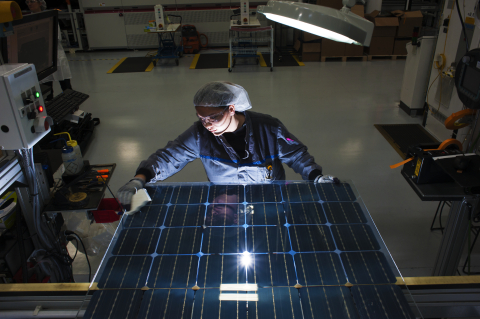 Production of two-sided solar panels by SolarWorld.This first commercial installation in the Americas will compare the performance of standard modules using advanced p-type mono-PERC (passivated emitter rear contact) cell architecture and Bisun modules using the same cell architecture. Both modules types will be installed on top of a gravel roof and a roof of vinyl-like white thermoplastic olefin to facilitate additional performance data comparisons. Actual power generation from bifacial modules depends on both the distance they are installed from a surface beneath them as well as the composition, and therefore reflectivity, of that surface.
SolarWorld will co-own the array with Secure Futures, based in Staunton, Va., which is developing the project. Under the first power purchase agreement within the service territory of utility Dominion Power Virginia, the University of Richmond will purchase power generated by the array. Installation is expected to conclude in the spring of 2016.