
Loop heat pipe harnesses waste heat
S. Himmelstein | September 17, 2024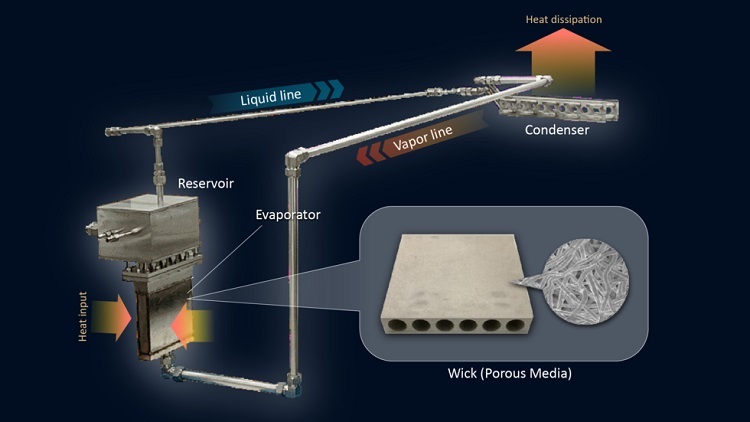 Source: Nagoya University
Prospects for exploiting industrial heat without relying on an electrical power source advance with the design of a high-capacity loop heat pipe system by researchers from Nagoya University, Japan. As the system can tap up to 10 kW of heat, it is considered to offer the largest heat transport capability available.
The flat-type evaporator kW-class loop heat pipe uses pure water as working fluid and a porous stainless-steel wick to transport heat efficiently over long distances. The wick draws the working fluid to the surface through capillary action. When heat is applied to the evaporator, the fluid on the wick's surface absorbs the heat and turns into vapor. This vapor travels to the condenser, where it releases the heat and condenses back into liquid. The liquid then returns to the compensation chamber, where it contacts the wick again, which draws it back to the surface and continues the cooling cycle.
Relative to previous loop heat pipe designs, this configuration delivered an 18% reduction in size, a 1.6 times increase in heat transport capability and a fourfold increase in heat transfer efficiency. The current design uses a thinner, longer and wider wick and narrowed channels that allow the vapor to escape from the evaporator. The benefits of such improvement were evident as the system transported waste heat over a distance of 2.5 m without power, using the capillary force generated by the wick. This set a record for non-power heat transport.
During tests with a gravity assist of 0.3 m, vertical evaporator orientation and natural convection, a 10 kW heat load was sustained at a steady-state temperature of 182° C for the evaporator.
The loop heat pipe described in the International Journal of Heat and Mass Transfer is envisioned for use in industrial waste heat recovery, solar heat utilization, electric vehicle thermal management and data center cooling.



