Video: Solar evaporator supports efficient water desalination
S. Himmelstein | February 20, 2023The speed and efficiency of seawater desalination are markedly improved with a solar evaporator system designed at King Abdullah University of Science and Technology (KAUST), Saudi Arabia.
The salt rejection evaporator described in Nature Communications is assembled as a centimeter-scale plastic cube containing several glass fiber membranes for filtration. A horizontally aligned membrane coated with carbon nanotubes serves as a light-absorbing layer on the structure's upper surface while underneath a series of vertically oriented membranes function as mass transfer bridges to separate the solar absorber from the salt water.
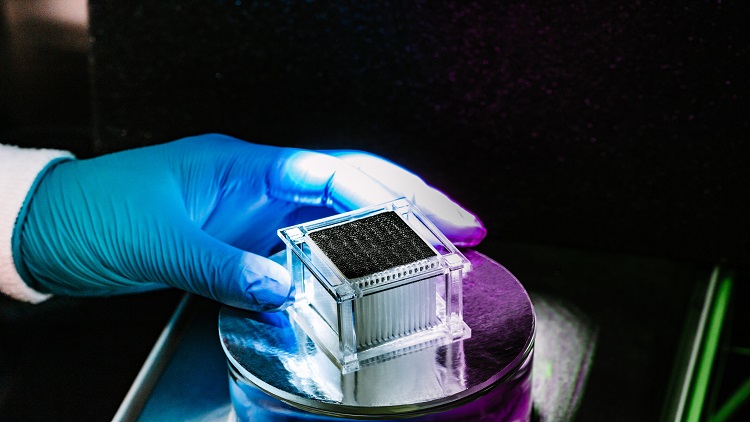 The desalination device is topped with a solar absorber and equipped with structures to enhance evaporation and salt rejection. Source: Anastasia Serin/KAUST
Hydrophilic microchannels in the bridges soak up and transfer seawater to the top solar layer for distillation into steam. The conductive heat generated during salt backflow Is harnessed by the solar still, improving evaporation efficiency. Excessive salt accumulation, a problem common to desalination systems, is prevented as these same microchannels also transport brine back into the seawater due to the capillary action of concentration gradients.
Laboratory and field tests documented a practical solar-to-water collection efficiency of greater than 40% and a daily freshwater generation rate of about 5 liters/m2. The researchers suggest that the drinking needs of more than two people can be met with a 1 m2 evaporator.